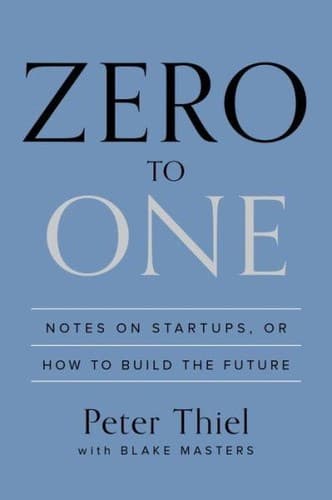
Zero to One: Notes on Startups, or How to Build the Future
By Peter Thiel and Blake Masters
Favorite quotes and key takeaways from this book.
“If you take one typewriter and build 100, you have made horizontal progress. If you have a typewriter and build a word processor, you have made vertical progress.”
Key takeaway
Horizontal goes from 1 to N while vertical goes from 0 to 1. Horizontal = globalization while vertical = technology I interpreted this more as, horizontal = building by analogy. So someone sees Snapchat and builds a “disapearing texting app”. Or Vine tries to build “instagram for video” and then Vertical is when you define a new category. Musk often talks about trying to build vertically using “first principle theory”
“New technology tends to come from new ventures - startups. From the Founding Fathers in politics to the Royal Society in science to Fairchild Semiconductor’s “traitorous eight” in business, small groups of people bound together by a sense of mission have changed the world for the better. The easiest explanation for this is negative: it’s hard to develop new things in big organizations, and it’s even harder to do it by yourself.”
Key takeaway
A startup is just a collection of people on the same mission. It is easier to create a startup with others than solo, but not too many others
“Business version of our contrarian question is: what valuable company is nobody building?”
Key takeaway
Don’t seek out competition, find a market that nobody is dominating and monopolize it
“But a great business is defined by its ability to generate cash flows in the future. Investors expect Twitter will be able to capture monopoly profits over the next decade, while newspapers’ monopoly days are over.”
Key takeaway
Don’t always focus on short term cash flow, most of the time all the value comes in the future
“Simply stated, the value of a business today is the sum of all the money it will make in the future. (To properly value a business, you also have to discount those future cash flows to their present worth, since a given amount of money today is worth more than the same amount in the future.”
Key takeaway
Value businesses by their growth potential, not necessarily what they are at the current moment
“Every monopoly is unique, but they usually share some combination of the following characteristics: proprietary technology, network effects, economies of scale, and branding.”
Key takeaway
monopolies have better tech, the ability to get better as the grow, the ability TO grow and great branding to tell this story
“The perfect target market for a startup is a small group of particular people concentrated together and served by few or no competitors.”
Key takeaway
Focus on a small market to start, preferably one that has no competition
“The most successful companies make the core progression - to first dominate a specific niche and then to scale to adjacent markets - a part of their founding narrative.”
Key takeaway
Most great companies all start by dominating a small niche
“PayPal could be seen as disruptive, but we didn’t try to directly challenge any large competitor. It’s true that we took some business away from Visa when we popularized internet payments: you might use PayPal to buy something online instead of using your VIsa card to buy it in a store. But since we expanded the market for payments overall, we gave Visa far more business than we took. The overall dynamic was net positive, unlike Napster’s negative-sum struggle with the U.S. recording industry. As you craft a plan to expand to adjacent markets, don’t disrupt: avoid competition as much as possible.”
Key takeaway
Instead of stealing market share away from competitors, create something that increases the market value so you don’t disrupt too many competitors
“From the Renaissance and the Enlightenment to the mid-20th century, luck was something to be mastered, dominated, and controlled; everyone agreed that you should do what you could, not focus on what you couldn’t. Ralph Waldo Emerson captured this ethos when he wrote: “Shallow men believe in luck, believe in circumstances...Strong men believe in cause and effect.” In 1912, after he became the first explorer to reach the South Pole, Roald Amundsen wrote: “Victory awaits him who has everything in order-luck, people call it.” No one pretended that misfortune didn’t exist, but prior generations believed in making their own luck by working hard.”
Key takeaway
Luck is where preparation meets opportunity
“Finance epitomizes indefinite thinking because it’s the only way to make money when you have no idea how to create.”
Key takeaway
Finance doesn’t actually create money, it just shuffles it around because people in finance for the most part can’t create anything to move society forward I think thats a little bold. “people in finance can’t create anything to move society forward”. The very foundation of what gives any chance to succeed, is Funding. VC is a form of finance.
“What would it mean to prioritize design over chance? Today, “good design” is an aesthetic imperative, and everybody from slackers to yuppies carefully “curates” their outward appearance. It’s true that every great entrepreneur is first and foremost a designer. Anyone who has held an iDevice or a smoothly machined MacBook has felt the result of Steve Job’s obsession with visual and experiential perfection. But the most important lesson to learn from Jobs has nothing to do with aesthetics. The greatest thing Jobs designed was his business. Apple imagined and executed definite multi-year plans to create new products and distribute them effectively. Forget “minimum viable products”-ever since he started Apple in 1976, Jobs saw that you can change the world through careful planning, not by listening to focus group feedback or copying others’ successes.”
Key takeaway
When people think of design they think of aesthetics but design can mean planning also. Jobs “designed” apple in a very particular way and then executed to perfection
“A business with a good definite plan will always be underrated in a world where people see the future as random.”
Key takeaway
Having a plan gives you a leg up on the competition that doesn’t
“Money makes money. “For whoever has will be given more, and they will have an abundance. Whoever does not have, even what they have will be taken from them” (Matthew 25:29). Albert Einstein made the same observation when he stated that compound interest was “the eighth wonder of the world, “ “the greatest mathematical discovery of all time,” or even “the most powerful force in the universe.” Whichever version you prefer, you can’t miss his message: never underestimate exponential growth."
Key takeaway
Startups are all about exponential growth Totally agree with this. Crazy to think about technological capabilities improving at exponential rate when we are older.
“The power law is not just important to investors; rather, it’s important to everybody because everybody is an investor. An entrepreneur makes a major investment just by sending her time working on a startup. Therefore every entrepreneur must think about whether her company is going to succeed and become valuable. Every individual is unavoidably an investor, too. When you choose a career, you act on your belief that the kind of work you do will be valuable decades from now.”
Key takeaway
Will what you’re doing now be around a decade from now? Does it have the ability to be worth more than everything else you’ve ever done combined?
“So when thinking about what kind of company to build, there are two distinct questions to ask: What secrets is nature not telling you? What secrets are people not telling you?”
Key takeaway
You can either create something from scratch that no one knew existed before, or create something for people that they never knew they needed before
“So who do you tell? Whoever you need to, and no more. In practice, there’s always a golden mean between telling nobody and telling everybody-and that’s a company. The best entrepreneurs know this: every great business is built around a secret that’s hidden from the outside. A great company is a conspiracy to change the world; when you share your secret, the recipe becomes a fellow conspirator.”
Key takeaway
Your secret is your true differentiator, a company is a group of people who all share that secret differentiation
“When you start something, the first and most crucial decision you make is whom to start it with. Choosing a co-founder is like getting married, and founder conflict is just as ugly as divorce.”
Key takeaway
You are basically marrying your co-founder, choose wisely
“Equity is a powerful tool precisely because of these limitations. Anyone who prefers owning a part of your company to being paid in cash reveals a preference for the long term and a commitment to increasing your company’s value in the future. Equity can’t create perfect incentives, but it’s the best way for a founder to keep everyone in the company broadly aligned.”
Key takeaway
Equity is a good judge of long term investment from an employee in a company. If they want cash then they are just in it for the short term and probably the money
“Since time is your most valuable asset, it’s odd to spend it working with people who don’t envision any long-term future together.”
Key takeaway
Time is valuable, spend it with people who are on the same business mission as you
“On the inside, every individual should be sharply distinguished by her work.”
Key takeaway
Everyone needs to bring a specific valuable asset to a start up
“We underestimate the importance of distribution-a catchall term for everything it takes to sell a product.”
Key takeaway
A great product won’t sell itself, distribution is another word for sales
“Like acting, sales works best when hidden. This explains why almost everyone whose job involves distribution-whether they’re in sales, marketing, or advertising-has a job title that has nothing to do with those things.”
Key takeaway
The best salespeople are the one’s who you don’t even realize are selling
“Two metrics set the limits for effective distribution. The total net profit that you earn on average over the course of your relationship with a customer (Customer Lifetime Value, or CLV) must exceed the amount you spend on average to acquire a new customer (Customer Acquisition Cost, or CAC)
Key takeaway
if CLV > CAC and then it’s a good sale
“Any prospective employee worth hiring will do his own diligence; what he finds or doesn’t find when he googles you will be critical to success of your company.”
Key takeaway
Telling your brand story via search and discovery is vital when people are doing their due diligence. Own your story, don’t let others hijack it (connect to Google ZMOT)
“Properly understood, technology is the one way for us to escape competition in a globalizing world. As computers become more and more powerful, they won’t be substitutes for humans: they’ll be complements.”
Key takeaway
Technology will help empower humans and differentiate them as we become a more globalized economy
“1. The Engineering Question: Can you create breakthrough technology instead of incremental improvements? 2. The Timing Question: Is now the right time to start your particular business? 3. The Monopoly Question: Are you starting with a big share of a small market? 4. The People Question: Do you have the right team? 5. The Distribution Question: Do you have a way to not just create but deliver your product? 6. The Durability Question: Will your market position be defensible 10 and 20 years into the future? 7. The Secret Question: Have you identified a unique opportunity that others don’t see?”
Key takeaway
These 7 questions must be addressed and designed if you want to have an uber successful company
“An entrepreneur can’t benefit from macro-scale insight unless his own plans begin at the micro-scale.”
Key takeaway
Dominate a niche market first and then expand