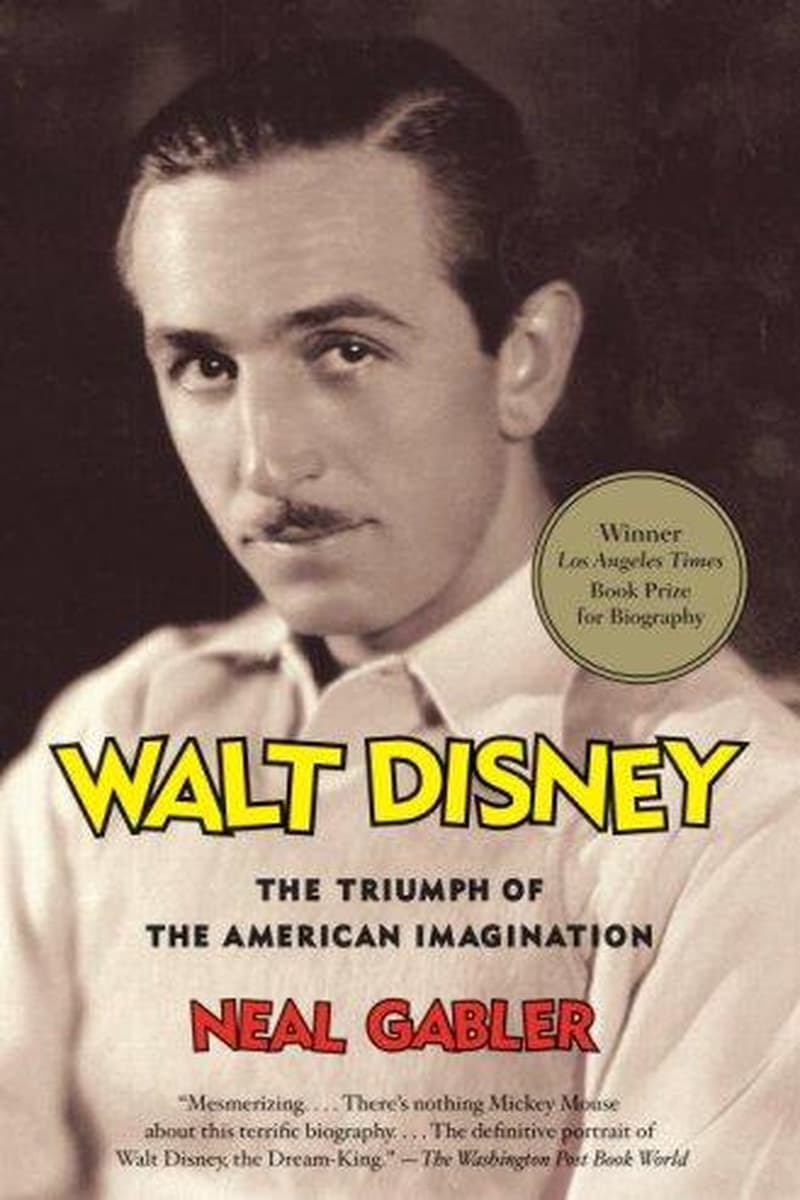
Walt Disney
By Neal Gabler
Favorite quotes and key takeaways from this book.
“In the late 1920s he began reinventing animation, gradually turning it from a novelty that emphasized movement and elasticity of line into an art form that emphasized character, narrative and emotion.”
Key takeaway
Walt legitimized animation by giving his characters emotion rather than just having them be cartoons
“Don’t be afraid to admit your ignorance,’ Doc Sherwood told him, a philosophy that Walk, who was always inquisitive, said “lasted me a lifetime.”
Key takeaway
It’s ok to admit there are known unknowns. This will always make you curious to learn more
“The process of animation was a process of giving life, of literally taking the inanimate and making it animate. It was, at base, a hubristic process in which the animator assumed and exercised godlike control over his materials, which was why it also offered a feeling of empowerment to its viewers who sensed the control. In Walt Disney’s case the surge of empowerment was so great one might even have concluded that animation took the place of religion for him, since in his adulthood he showed little or no interest in formal religion and never attended church.”
Key takeaway
Animation at it’s very core is giving life to the inanimate which is eerily representative of God
“But what made it different from its animation forebears and competitors was the extent to which Walt had imagined it fully as a sound cartoon in which the music and effects were inextricable from the action—truly a musical cartoon rather than a cartoon with music.”
Key takeaway
When you break something down and build it for the medium, it will be of higher quality than force fitting into an older paradigm
“Walt, as fervent as ever that quality was his only real advantage, was determined to spend as much on his cartoons as producers were spending on their live one-reel comedies.”
Key takeaway
Quality is the best differentiation for content
“In Walt’s eyes, his studio was not to be subject to the pressures of the world; it was his refuge from them—a sacred place. And his animations could not be compromised; they had to be better than anyone else’s or he would not survive in the business; nor would he want to survive. Excellence was not only Walt’s business strategy, it was the reason he ran the studio and the force that kept his personal world intact.”
Key takeaway
Walt was always after excellence and everything else followed after that
“If you want to know the real secret of Walt’s success,” longtime animator Ward Kimball would say, “it’s the he never tried to make money. He was always trying to make something that he could have fun with or be proud of.”
Key takeaway
This at it’s core is a paradox, whereby not focusing on trying to make money can often be the best way to make money
“The most important aim of any of the fine arts is to get a purely emotional response from the beholder.”
Key takeaway
Art is really about making emotional connections with those experiencing it
“The only way to elicit that response, Walt believed, was through personality—a set of characteristics that were unique to the character and that coalesced to define him. At the Disney studio the edict came down from Walt that animated figures were no longer to be simply functional for the gag. They had to be full-bodied or, as one animator described it, “believable in motion and emotion.”
Key takeaway
Walt brought his animations to life by giving them true humanistic emotions
“Walt Disney was in the business of creating life. “Most people think the word ‘animation’ means movement,” Ken Peterson, a Disney animator, once explained, “but it doesn’t. It comes from ‘animus’ which means ‘life’ or ‘to live.’ Making it move is not animation, but just the mechanics of it.” “We invest them with life,” Walt told a reporter of his animated creations.”
Key takeaway
Animate at its root term means giving life which means animation is just giving life to the inanimate
“The process always began with the story.”
Key takeaway
Walt cared most about the story and need a quality story would trump all
“Look, the thing that’s going to make Disneyland unique and different,” he insisted, “is the detail. If we lose the detail, we lose it all.”
Key takeaway
From the movies all the way to the theme park, Walt always cared about the quality of the details because he knew that this was his key differentiator
“Walt was obsessed with the idea that in life you just continually go to school. You never reach any plateau of perfection.”
Key takeaway
Walt was always in permanent beta, striving to get better