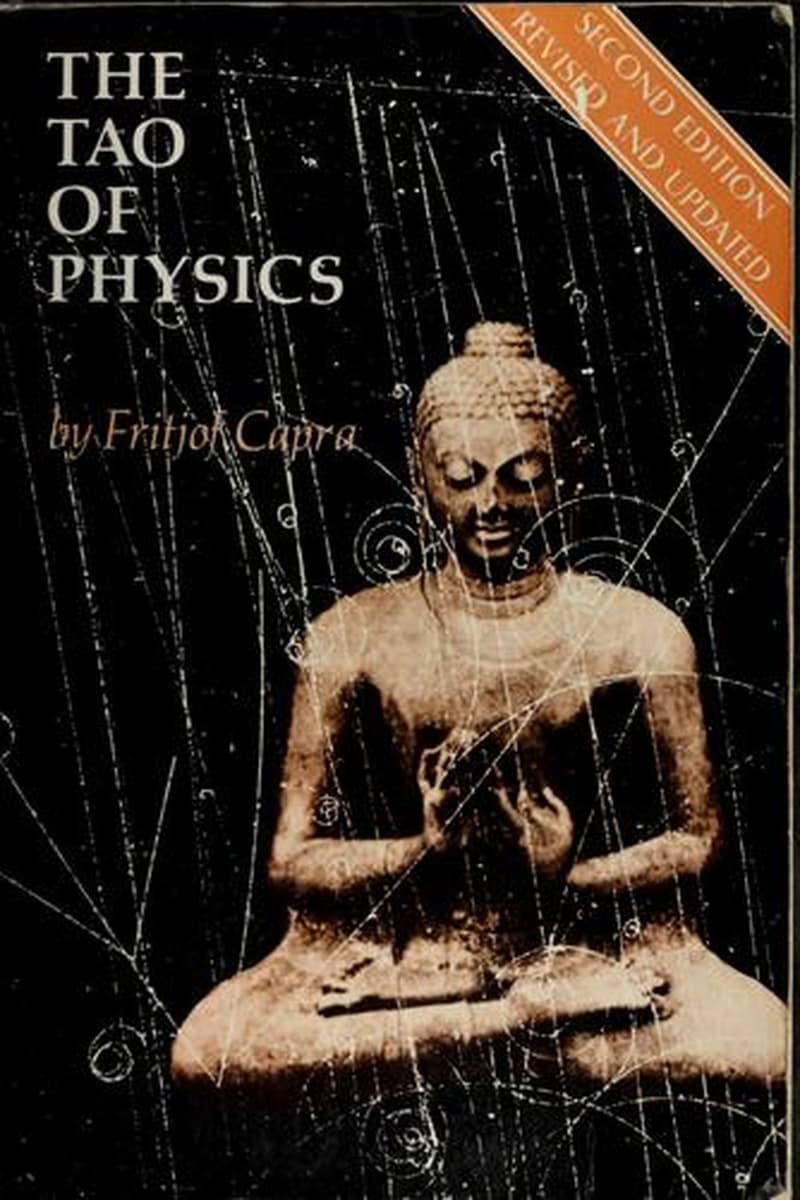
The Tao of Physics
By Fritjof Capra
Favorite quotes and key takeaways from this book.
“Zen Buddhists say that a finger is needed to point at the moon, but that we should not trouble ourselves with the finger once the moon is recognized.”
Key takeaway
We may need to use our perception to get to the ultimate reality but once we are there we can let go of our perception of the world
“The map is not the territory.”
Key takeaway
Don’t confuse perception with reality
“The rational part of research would, in fact, be useless if it were not complemented by the intuition that gives scientists new insights and makes them creative. These insights tend to come suddenly, and, characteristically, not when sitting at a desk working out the equations but when relaxing, in the bath, during a walk in the woods, on the beach, and so forth. During these periods of relaxation after concentrated intellectual activity, the intuitive mind seems to take over and can produce the sudden clarifying insights which give so much joy and delight to scientific research.”
Key takeaway
Scientists still rely on intuition for the eureka moments that come from rational experiments
“Indian mystics, and Hinduism in particular, clothe their statements in the form of myths, using metaphors and symbols, poetic images, similes, and allegories. Mythical language is much less restricted by logic and common sense. It is full of magic and of paradoxical situations, rich in suggestive images, and never precise, and can thus convey the way in which mystics experience reality much better than factual language.”
Key takeaway
Myths are less restricted and thus do a better job at describing mystical experiences than logical language
“The human observer constitutes the final link in the chain of observational processes, and the properties of any atomic object can only be understood in terms of the objects; interaction with the observer.”
Key takeaway
The observer is forever linked to the experiment and cannot be detached from what he is explaining
“Enlightenment in Zen does not mean withdrawal from the world, but means, on the contrary, active participation in everyday affairs.”
Key takeaway
Zen means going with the flow of everything
“By the very act of focusing our attention on any one concept we create its opposite. As lAo Tzu says, “When all in the world understand beauty to be beautiful, then ugliness exists; when all understand goodness to be good, then evil exists.”
Key takeaway
When we create this, we also create that
“The conservation of energy is one of the most fundamental laws of physics.”
Key takeaway
Energy can neither be created nor destroyed
“Thus one can explain many phenomena in terms of a few, and consequently understand different aspects of nature in an approximate way without having to understand everything at once.”
Key takeaway
First principle reasoning is the best we can do for now
“In its most ancient meaning, it signified the pattern in things, the markings of jade or fibres in muscle. . . . It acquired the common dictionary meaning “principle,” but always conserved the undertone of “pattern.”
Key takeaway
Principles are really just patterns
“The Tower is as wide and spacious as the sky itself. The ground is paved with (innumerable) precious stones of all kinds, and there are within the Tower (innumerable) palaces, porches, windows, staircases, railings, and passages, all of which are made of the seven kinds of precious gems. . . . And within this Tower, spacious and exquisitely ornamented, there are also hundreds of thousands . . . of towers, each one of which is as exquisitely ornamented as the main Tower itself and as spacious as the sky. And all these towers, beyond calculation in number, stand not at all in one another’s way; each preserves its individual existence in perfect harmony with all the rest; there is nothing here that bars one tower being fused with all the others individually and collectively; there is a state of perfect intermingling and yet of perfect orderliness. Sudhana, the young pilgrim, sees himself in all the towers as well as in each single tower, where all is contained in one and each contains all.”
Key takeaway
A myth that shows the idea of fractal knowledge and how everything is interconnected and thus goes on forever
“In the heaven of Indra, there is said to be a network of pearls, so arranged that if you look at one you see all the others reflected in it. In the same way each object in the world is not merely itself but involves every other object and in fact is everything else. “In every particle of dust, there are present Buddhas without number.”
Key takeaway
To see something is to see everything in it
“To see a world in a grain of sand And a heaven in a wild flower, Hold infinity in the palm of your hand, And eternity in an hour.”
Key takeaway
Everything is interconnected and the same
“Thus the mystic and the physicist arrive at the same conclusion; one starting from the inner realm, the other from the outer world. The harmony between their views confirms the ancient Indian wisdom that Brahman, the ultimate reality without, is identical to Atman, the reality within.”
Key takeaway
Doesn’t matter if you start inward or outward, you end at the same place
“The behavior of any part is determined by its nonlocal connections to the whole, and since we do not know these connections precisely, we have to replace the narrow classical notion of cause and effect by the wider concept of statistical causality.”
Key takeaway
Since we cannot know everything at once we must use statistics to approximate
“Probability, then, is used in classical and quantum physics for similar reasons. In both cases there are “hidden” variables, unknown to us, and this ignorance prevents us from making exact predictions.”
Key takeaway
Probability is being aware of the known unknowns
“If one is satisfied with an approximate understanding of nature, one can describe selected groups of phenomena in this way, neglecting other phenomena that are less relevant. Thus one can explain many phenomena in terms of a few, and consequently understand different aspects of nature in an approximate way without having to understand everything at once.”
Key takeaway
First principle thinking