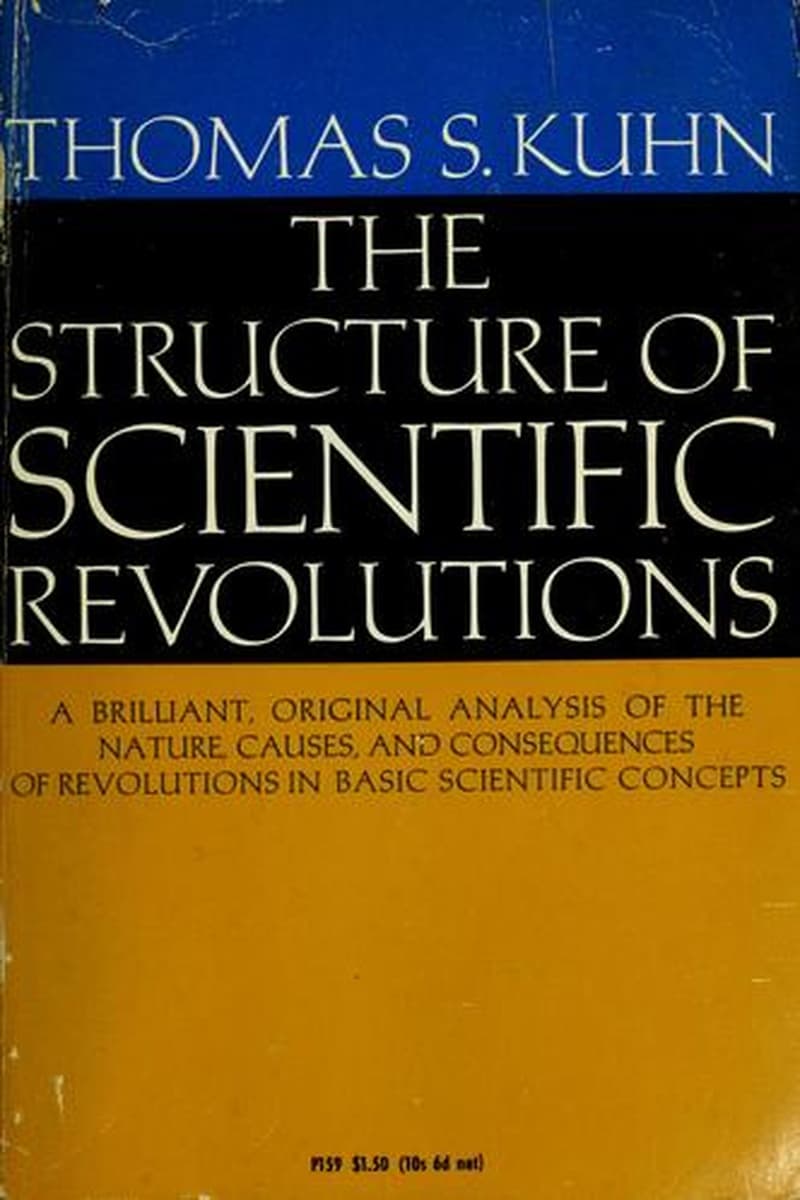
The Structure of Scientific Revolutions
By Thomas S. Kuhn
Favorite quotes and key takeaways from this book.
“You have to learn that a group of these problems, seemingly disparate, can be solved by using similar techniques. In solving those problems you grasp how to carry on using the “right” resemblances. “The student discovers a way to see his problem as like a problem he has already encountered. Once that likeness or analogy has been seen, only manipulative difficulties remain.”
Key takeaway
Framing the problem is the difficult part, but once you can put it into terms you already know, it is seemingly easier to execute
“Publishing in 1974, he could say that work on sociology of the sciences developed in the 1960s enables one to have sharp empirical tools for distinguishing scientific communities. There is no question about what a scientific community “is.” The question is what binds its members together as working in the same discipline. Although he does not say so, this is the fundamental sociological question to be asked of any identified group, large or small, be it political, religious, ethnic, or simply a soccer club for teenagers, or a group of volunteers who deliver meals on wheels to the elderly. What keeps the group together as a group? What will cause the group to divide into sects, or simply to fall apart? Kuhn answered in terms of paradigms.”
Key takeaway
Friend groups, teams, startups, tribes are what they are because they all believe in the same model (loosely). They all agree on a system (those that succeed). Sometimes a shift in thinking can cause new groups to break off or new sects to form
“We have a tendency to see what we expect, even when it is not there. It often takes a long time for an anomaly to be seen for what it is, something contrary to the established order.”
Key takeaway
Confirmation bias often fogs our view on the world and prevents us from seeing contrarian thoughts
“This is not progress towards a pre established goal. It is progress away from what once worked well, but no longer handles its own new problems.”
Key takeaway
Contrarian thoughts don’t necessarily go towards something, they go away from predisposed ways of thinking
“If, for example, the student of Newtonian dynamics ever discovers the meaning of terms like ‘force, mass, space and time, he does so less from the incomplete though sometimes helpful definitions in his text than by observing and participating in the application of these concepts to problem-solution.”
Key takeaway
You learn better through hands on experience
“Discovery commences with the awareness of anomaly, i.e., with the recognition that nature has somehow violated the paradigm-induced expectations that govern normal science. It then continues with a more or less extended exploration of the area of anomaly. And it closes only when the paradigm theory has been adjusted so that the anomalous has become the expected.”
Key takeaway
Discovery occurs when something doesn’t match expectations. It remains a discovery until the expectations have shifted to include the result
“The decision to reject one paradigm is always simultaneously the decision to accept another, and the judgement leading to that decision involves the comparison of both paradigms with nature and with each other.”
Key takeaway
Everything has trade offs
“Handling the same bundle of data as before, but placing them in a new system of relations with one another by giving them a different framework.”
Key takeaway
Scientific advancement takes place by just changing the scope and the worldview
“What a man sees depends both upon what he looks at and also upon what his previous visual-conceptual experience has taught him to see.”
Key takeaway
Paradigms influence perception
“The child who transfers the word ‘mama’ from all humans to all females and then to his mother is not just learning what ‘mama’ means or who his mother is. Simultaneously he is learning some of the differences between males and females as well as something about the ways in which all but one female will behave toward him. His reactions, expectations, and beliefs - indeed, much of his perceived world - change accordingly.”
Key takeaway
Paradigms shift as you learn new knowledge