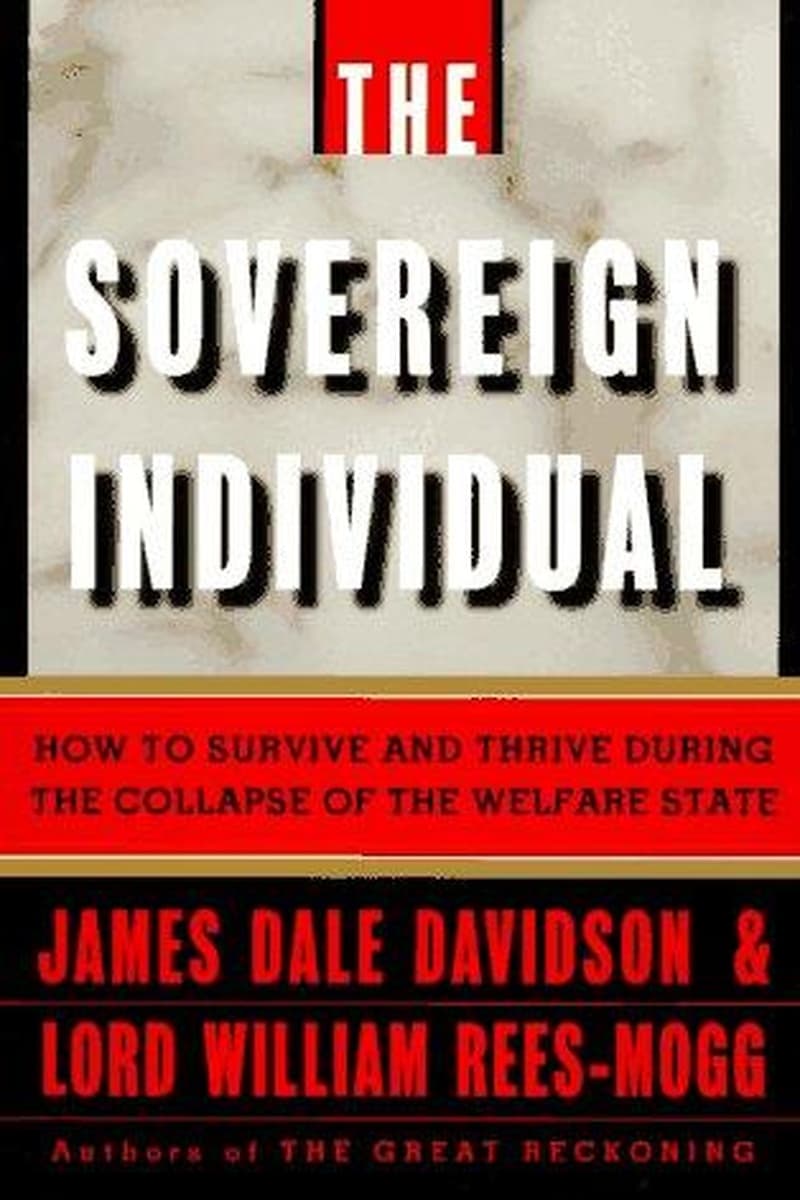
The Sovereign Individual
By James Dale Davidson and William Rees-Mogg
Favorite quotes and key takeaways from this book.
“The state has grown used to treating its taxpayers as a farmer treats his cows, keeping them in a field to be milked. Soon, the cows will have wings.”
Key takeaway
The internet is empowering everyone which means you can’t keep people oppressed forever
“This nostalgia for the past will be fed by resentments inflamed by the inevitable transition crisis. The greatest resentment is likely to be centered among those of middle talent in currently rich countries. They particularly may come to feel that information technology poses a threat to their way of life. The beneficiaries of organized compulsion, including millions receiving income redistributed by governments, may resent the new freedom realized by the Sovereign Individuals.”
Key takeaway
Helps explain the current transition crisis and Trump fanning the flames
“The bird that falls asleep on the back of a hippopotamus does not think about losing its perch until the hippo actually moves.”
Key takeaway
The internet is going to be a rude wake up for a lot of people
“Machinery is aggressive. The weaver becomes a web, the machinist a machine. If you do not use tools, they use you.”
Key takeaway
Control the internet or it will control you
“The small scale of foraging bands was advantageous in another way. Members of such small groups would have known one another intimately, a factor that made them more effective in working together. Decision-making becomes more difficult as numbers rise, because incentive traps proliferate. You need only think how hard it is to get a dozen people organized to go out to dinner.”
Key takeaway
Being nimble is an advantage and why Amazon has two pizza teams
“Whenever technological change has divorced the old forms from the new moving forces of the economy, moral standards shift, and people begin to treat those in command of the old institutions with growing disdain.”
Key takeaway
Once you see a new paradigm shift you can’t unsee it
“As the scale of technology plunges, governments will find that they must compete like corporations for income, charging no more for their services than they are worth to the people who pay for them. The full implications of this change are all but unimaginable.”
Key takeaway
Governments are susceptible to market forces as well, especially if tech companies can leverage their scale
“Among the elements that the new technology of printing helped reveal was the corruption of the Church, whose hierarchy as well as rank and file were already held in low regard by a society that paradoxically placed religion at the center of everything. It is a paradox with an obvious contemporary parallel in the disillusionment with politicians and bureaucrats, in a society that places politics at the center of everything.”
Key takeaway
The internet is exposing the corruption in government much like the printing press did for the church back during the industrial revolution
“In principle, these businesses could be conducted almost anywhere on the planet. They are not trapped at a specific location, like a mine or a port. Therefore, in the fullness of time, they will be far less susceptible to being taxed, either by unions or by politicians. An old Chinese folk wisdom holds, “Of all the thirty-six ways to get out of trouble, the best way is to leave.”
Key takeaway
You can’t tax a decentralized network. Moving around will make things difficult for governments
“Microprocessing individualizes work. Industrial technology standardized work.”
Key takeaway
Computers give the power to the individual whereas machinery gave power to companies
“Among the more important is the fact that where output varies, incomes vary as well. Most of the value in fields where skill varies will tend to be created by a small number of persons. This is a common characteristic of the most highly competitive markets. It is quite evident, for example, in sports. Many millions of young people worldwide play various versions of football. But 99 percent of the money spent to watch football games is paid to see the performances of a tiny fraction of the total number of players.”
Key takeaway
The internet turns the world into a giant competition, a giant market. The best of the best will surface and gain outsized profits
“Access creates globalism, and globalism disrupts political systems by making the concept of borders obsolete. As borders disappear, the concept of taxation, which supports governments, becomes increasingly fragile...As borders disappear, the concept of entitlement — the belief that because you were born in a particular place — falls apart, and as it falls apart, the perks of nationhood fall apart with it.”
Key takeaway
The internet knocks down geographic borders and everything built on those physical borders falls with it
“In the age of the virtual corporation, individuals will choose to domicile their income-earning activities in a jurisdiction that provides the best service at the lowest cost. In other words, sovereignty will be commercialized...In short, governments will be obliged to give customers what they want.”
Key takeaway
Internet shifts power from supply to demand. The people have the power
“Cyberspace transcends locality. It involves nothing less than the instantaneous sharing of data everywhere and nowhere at once.”
Key takeaway
The internet is a paradox!
“The odds of finding someone with exactly reciprocal desires to yours increase dramatically when you can sort instantly across the entire world rather than drawing on only those whom you might meet locally.”
Key takeaway
This is why the internet enables massive marketplaces
“Virtual reality will create almost unlimited licensing opportunities that will nevertheless command only microroyalty payments. One day you will be able to replay the third game of the 1969 World Series, and pay microroyalties to the players whose images are used to make your virtual reality seem real.”
Key takeaway
Micropayments can coincide very nicely with virtual worlds
“If the world operates as one big market, every employee will compete with every person anywhere in the world who is capable of doing the same job. There are lot of them and many of them are hungry. -Andy Grove”
Key takeaway
The internet turns the world into one giant market which is susceptible to market forces
“The new megapolitical conditions of the twenty-first century will allow market tests to regulate outcomes in areas formerly dominated by politics. The market paradigm presupposes that results can be better regulated by rewarding desirable outcomes and penalizing undesirable ones.”
Key takeaway
The government cannot beat the market, especially in the internet era
“The microprocessing revolution is sharply increasing the availability of information and reducing transaction costs. This is devolving the firm. Instead of permanent bureaucracy, activities will be organized around projects, in much the way that movie companies already operate. Most of the formerly “internal” functions of the firm will be outsourced to independent contractors.”
Key takeaway
Companies are turning into movies, gathering of talent for specific projects.
“The model business organization of the new information economy may be a movie production company. Such enterprises can be very sophisticated, with budgets of hundreds of millions of dollars. While they are often large operations, they are also temporary in nature.”
Key takeaway
Movies are the ultimate operation. Go Hollywood!
“The economic value of memorization as a skill will fall, while the importance of synthesis and creative application of information will rise.”
Key takeaway
When you have the worlds information at your fingertips, how you connect the dots is more important than than memorizing the dots themselves
“An intense and even violent nationalist reaction centered among those who lose status, income, and power when what they are consider to be their “ordinary life” is disrupted by political devolution and new market arrangements. Among the features of this reaction: a) Suspicion of and opposition to globalization, free trade, foreign ownership and penetration of local economies. b) hostility to immigration especially of groups that are visibly different from the former national group, c) popular hatred of the information elite, rich people, the well educated, and complaints about capital flight and disappearing jobs, d) extreme measures by nationalists intent upon halting the secession of individuals and regions from faltering nation-states, including resort to wars and acts of ethnic cleansing that reinforce nationalist identification with the state and rationalize the states claims on people and their resources...b) Reactionary sentiments will be most intensely felt within the currently rich countries, and especially in communities with high percentages of the value poor and skill poor who previously enjoyed high incomes….9) The nationalist reaction will peak in the early decades of the new millenium, then fade as the efficacy of fragmented sovereignties proves superior to the massed power of the nation state. We suspect that the congenital bullying by nation states of alternative jurisdictions, exemplified by the Russian invasion of Chechnya, will tend to deprive nations and nationalists fanatics of the sympathy of the new generations that come to maturity under the megapolitical conditions of the Information Age.”
Key takeaway
Trump is capitalizing on the paradigm shift and others are slow to respond
“Human desires are ultimately adaptive responses shaped by man’s biological nature and situation on earth.”
Key takeaway
Humans adapt, its in our DNA
“A factory worker was paid either on the basis of hours in attendance as measured by the time clock, or according to some criterion of output, such as pieces made, units assembled, or some similar measure. Standardized pay was made possible by the fact that output was similar for everyone using the same tools. But the creation of conceptual wealth, like artistic performance, varies dramatically among persons using the same tools. In this respect, the whole of the economy is becoming increasingly like opera, where the highest rewards go to those with the best voices, and those who sing out of tune, however earnestly, do not normally attract large rewards.”
Key takeaway
The internet enables a winner take all market. 80/20 goes to 99/1
“Within the next fed decades, for example, narrow casting will replace broadcasting as the method by which individuals obtain their news. This has significant implications. It amounts to a change in the imaginations of millions from first personal plural to singular. As individuals themselves begin to serve as their own news editors, selecting what topics and news stories are of interest, it is far less likely that they will choose to indoctrinate themselves in the urgencies of sacrifice for the nation state. Indeed, their attitudes are more likely to be informed by the global culture to which they relate as consumers of entertainment than by the highly personal news narrow casts to which they may subscribe. Much the same effect will arise from the privatization of education, again facilitated by technology.”
Key takeaway
When people are in control, who knows what they will subscribe to, but it probs wont be the government
“Competition usually improves customer satisfaction.”
Key takeaway
Markets put customer needs first
“In a world of artificial reality and instantaneous transmission of everything everywhere, integrity of judgement and the ability to distinguish the true from the false will be even more important.”
Key takeaway
this is why being good at ‘googling’ something is a high paying job
“Countries go through a cycle, which formed the basis of Adam Ferguson’s sociological theory in the eighteenth century, from poverty and hard work, to riches, to luxury, to decadence, and on to decline.”
Key takeaway
Humans adapt and get used to things and inevitably fall because of it
“Since 1776, it has been evident that the best way to optimize the wealth of nations is to allow individuals to optimize their own return on capital in the conditions of free competition.”
Key takeaway
Markets solve everything
“The archetype of collaborative competition is the merchant. It is in the interest of the merchant that the customer should be satisfied with the transaction, because only a satisfied customer comes back for more trade.It is also in the interest of the merchant that the customer should be prosperous, because a prosperous customer has the money to go on buying. Conquest implies the destruction of the other company, commerce implies the satisfaction of the other party.”
Key takeaway
Markets have aligned incentives. Make something that people want
“The cyber economy will be a high trust community.”
Key takeaway
When you digitize everything trust is at the utmost importance.
“Success in business, as in most cases in life, depends upon being able to solve problems. If you can teach yourself how to solve problems, you have a bright career ahead of yourself.”
Key takeaway
Adapt or die