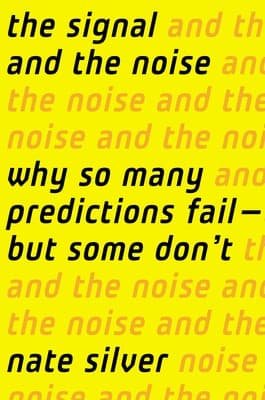
The Signal and the Noise
By Nate Silver
Favorite quotes and key takeaways from this book.
“Our biological instincts are not always very well adapted to the information-rich modern world. Unless we work actively to become aware of the biases we introduce, the returns to additional information may be minimal - or diminishing.”
Key takeaway
You need to actively seek your blind spots if you want to not have confirmation bias with data and information
“Sports and games, because they follow well-defined rules, represent good laboratories for testing our predictive skills. They help us to a better understanding of randomness and uncertainty and provide insight about how we might forge information into knowledge.”
Key takeaway
Because sports and games have rules (constant for the most part), it is easier to test hypothesis and find signals amidst the noise. Sports and games are a good place to test predictions
“Leverage, or investments financed by debt.”
Key takeaway
Leverage is investment financed by debt. When you leverage an influencer, you go into debt but invest in their ability to get results
“The word objective is sometimes taken to be synonymous with quantitative, but it isn’t. Instead it means seeing beyond our personal biases and prejudices and toward the truth of a problem.”
Key takeaway
Being objective is being aware of your biases and prejudices.
“Good innovators typically think very big and they think very small.”
Key takeaway
Innovators have the long term vision of scaling but start out by dominating a niche market
“And yet while the notion that aggregate forecasts beat individual ones is an important empirical regularity, it is sometimes used as a cop-out when forecasts might be improved. The aggregate forecast is made up of individual forecasts; if those improve, so will the group’s performance. Moreover, even the aggregate economics forecasts have been quite poor in any real-world sense, so there is plenty of room for progress.”
Key takeaway
The combined efforts together are a better predictor than the individual. But don’t lose sight that you can improve things on an individual scale to increase the overall groups performance
“The key is in remembering that a model is a tool to help us understand the complexities of the universe, and never a substitute for the universe itself.”
Key takeaway
a model is just a tool to help us explain the universe. It is never the undeniable truth, only our best effort at the truth
“The bayesian viewpoint, instead, regards rationality as a probabilistic matter. In essence, Bayes and Price are telling Hume, don’t blame nature because you are too daft to understand it: if you step out of your skeptical shell and make some predictions about its behavior, perhaps you will get a little closer to the truth.”
Key takeaway
Predicting is just an attempt to get closer to the truth. It is us who don’t understand nature, but predicting is our best bet at learning the truth
“This does not imply that all prior beliefs are equally correct or equally valid. But I’m of the view that we can never achieve perfect objectivity, rationality, or accuracy in our beliefs. Instead, we can strive to be less subjective, less irrational, and less wrong. Making predictions based on our beliefs is the best (and perhaps even the only) way to test ourselves.”
Key takeaway
We all have biases formed from our own experiences. Applying the Bayesian theory is trying to become aware of these biases and making predictions after acknowledging them
“Elite chess players tend to be good at metacognition - thinking about the way they think - and correcting themselves if they don’t seem to be striking the right balance.”
Key takeaway
Thinking objectively is thinking about the way you think. Become aware of your biases and then use that to make better predictions.
“Blitzing your opponent with a deluge of possibilities is the best way to complicate his probability calculations.”
Key takeaway
Referring to poker but could be used in many other scenarios (football for instance)
“But if you’re approaching prediction as more of a business proposition, you’re usually better off finding someplace where you can be the big fish in a small pond.”
Key takeaway
Big fish in a small pond is better than a small fish in a big pond. Similar to Thiels monopoly theory
“Control. When we play poker, we control our decision making process but not how the cards come down. If you correctly detect an opponent’s bluff, but he gets a lucky card and wins the hand anyway, you should be pleased rather than angry, because you played the hand as well as you could. The irony is that by being less focused on your results, you may achieve better ones.”
Key takeaway
Focus on the process rather than the results. Similar to HTSAS in that the actual idea for a start up will hit you when you least expect it if you are viewing the world from a start up mentality and process
“The more eagerly we commit to scrutinizing and testing our theories, the more readily we accept that our knowledge of the world is uncertain, the more willingly we acknowledge that perfect prediction is impossible, the less we will live in fear of our failures, and the more liberty we will have to let our minds flow freely. By knowing more about what we don’t know, we may get a few more predictions right.”
Key takeaway
Identifying your blind spots (that are infinite) will help you get more predictions right by knowing more of the unknown
“In many walks of life, expressions of uncertainty are mistake for admissions of weakness.”
Key takeaway
The opposite is true, Knowing what you don’t know is an advantage and can help with probabilistic predictions
“Bayes’s theorem requires us to state - explicitly - how likely we believe an event is to occur before we begin to weigh the evidence. It calls this estimate a prior belief.”
Key takeaway
Bayes theory is explicitly confronting your biases and factoring them in (stating them) before making a prediction
“Information becomes knowledge only when it’s placed in context. Without it, we have no way to differentiate the signal from the noise, and our search for the truth might be swamped by false positives.”
Key takeaway
Data is not an insight. You need to add context to everything to understand it better
“In the real world, they rarely come when you are standing in place. Nor do the “big” ideas necessarily start out that way. It’s more often with small, incremental, and sometimes even accidental steps that we make progress.”
Key takeaway
Continue to make predictions and refine your model and that will ultimately lead you to the truth, or the closest you can possibly come.