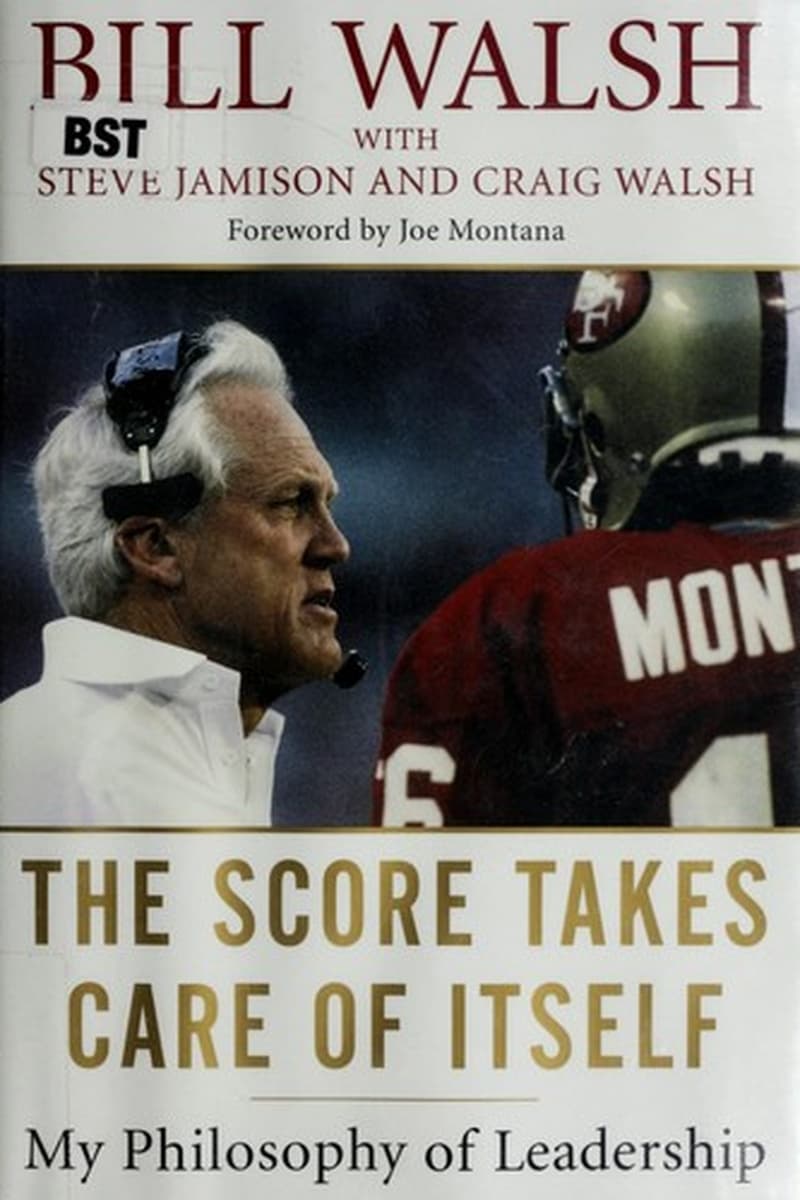
The Score Takes Care of Itself
By Bill Walsh
Favorite quotes and key takeaways from this book.
“However, a resolute and resourceful leader understands that there are a multitude of means to increase the probability of success. And that’s what it all comes down to, namely, intelligently and relentlessly seeking solutions that will increase your chance of prevailing in a competitive environment. When you do that, the score will take care of itself.”
Key takeaway
There is no sure thing but you can increase your odds of success by doing the little things right
“A philosophy is the aggregate of your attitudes toward fundamental matters and is derived from a process of consciously thinking about critical issues and developing rational reasons for holding one particular belief or position rather than another.”
Key takeaway
A philosophy is what you apply through a carefully thought out decision making process. Your beliefs
“By adhering to your philosophical tenets you are provided with a systematic, yet practical, method of deciding what to do in a particular situation.”
Key takeaway
A philosophy provides a consistent framework for making decisions in the face of new obstacles and challenges
“My Standard of Performance - the values and beliefs within it - guided everything I did in my work at San Francisco and are defined as follows: Exhibit a ferocious and intelligently applied work ethic directed at continual improvement; demonstrate respect for each person in the organization and the work he or she does; be deeply committed to learning and teaching, which means increasing my own expertise; be fair; demonstrate character; honor the direct connection between details and improvement, and relentlessly seek the latter; show self-control, especially where it counts most - under pressure; demonstrate and prize loyalty; use positive language and have a positive attitude; take pride in my effort as an entity separate from the result of that effort; be willing to go the extra distance for the organization; deal appropriately with victory and defeat, adulation and humiliation (don’t get crazy with victory nor dysfunctional with loss); promote internal communication that is both open and substantive (especially under stress); seek poise in myself and those I lead; put the team’s welfare and priorities ahead of my own; maintain an ongoing level of concentration and focus that is abnormally high; and make sacrifice and commitment the organization’s trademark.”
Key takeaway
This was Bill Walsh’s roadmap to success, which he could reference and hand out to all employees and team members
“The culture precedes positive results.”
Key takeaway
The process needs to come first before anything
“The key to performing under pressure at the highest possible level, regardless of circumstance, is preparation in the context of your Standard of Performance and a thorough assimilation by your organization of the actions and attitudes contained within your philosophy of leadership. With that comes the knowledge that you -and they - can step into that high-pressure arena and go about your work while the score works itself out. Rather than feel that somehow I had to get a supreme effort from our personnel - “try harder and harder” - I trusted that it was going to happen because we had prepared thoroughly.”
Key takeaway
If you prepare thoroughly than you can rely on that preparation in high-pressure circumstances
“When you’re thorough in your preparation - “scripting” is a part of it - you can almost go on automatic pilot and reduce the chance of making emotional and ill-considered decisions. Scripting allowed me to take randomness and stress out of the decision-making process. The result is a very adaptable but intelligent plan for the future.”
Key takeaway
Preparation helps reduce stress and provides you something to fall back on when emotions kick in
“Regardless of context, competitive endeavors at the highest level are fluid and ever-changing and constantly present new challenges requiring novel solutions. The advent of a Lawrence Taylor in the NFL and its existential threat to my offensive philosophy is no different from the kind of challenges a company faces regularly from competitors. When a threat like this occurs, we cannot allow ourselves to hope for the best or wait to see how bad the damage might be. A leader must be perceptive and respond swiftly.”
Key takeaway
A leader must be willing to adapt depending on the new obstacles that inevitably present themselves
“Bill prized communication and understood that all the knowledge in the world meant little if you couldn’t communicate effectively.”
Key takeaway
What good is knowing something if you can’t communicate it to another human being
“Good logic, sound principles, and strong belief are the purest and most productive reasons for pushing forward when things get rough.”
Key takeaway
Having a map (or philosophy) can help guide you when things get tough
“The great leaders in sports, business, and life always have the most powerful and positive inner voice talking to them, which they, in turn, share with and teach to their organization. The specifics of that inner voice varies from leader to leader, but I believe all have these four messages in common: 1. We can win if we work smart enough and hard enough 2. We can win if we put the good of the group ahead of our own personal interests 3. We can win if we improve. And there is always room for improvement 4. I know what is required for us to win. I will show you what it takes.”
Key takeaway
The inner voice leading you should be positive
“If you’re growing a garden, you need to pull out the weeds, but flowers will die if all you do is pick weeds. They need sunshine and water. People are the same. They need criticism, but they also require positive and substantive language and information and true support to really blossom.”
Key takeaway
Positive reinforcement will help people grow
“I wanted to work with people smart enough to have independent thinking but strong enough to change their opinion when evidence or logic suggested it.”
Key takeaway
Independent thinking is necessary, but don’t be stubborn, leaders show they can change their mind in the presence of new info
“I wanted no separate divisions where people felt that the only thing that mattered was their specific area of responsibility, that somehow their welfare was separate from that of the rest of us. Steve was like that - a team player.”
Key takeaway
“not my problem” is not the mindset you want employees to have. Everyone should be invested in the company's well-being
“Mastery requires endless remastery.”
Key takeaway
Always be learning
“Commitment and sacrifice are among personal characteristics I value most highly in people.”
Key takeaway
Those willing to commit and sacrifice for the greater good are the people you want on your team
“To put it another way: Conventional wisdom often produces conventional results.”
Key takeaway
Thinking like everyone else will lead to results like everyone else. Innovative thinking will lead to innovative results
“Positive results - winning - count most. But until those results come through your door, a heavy dose of documentation relating to what you’ve done and what you’re doing, planning to do, and hoping to do may buy you just enough extra time to actually do it.”
Key takeaway
Documenting your process allows you to tweak it easier and sets you up for success
“We learn in many ways from many sources. One of the most powerful is a mentor, usually thought of as an older, wiser person who takes you under his wing - provides ongoing teaching, counsel, direction, experience, and moral support. But being mentored can also be simply a matter of keen observation, analysis, and learning by the “student,” whether there is any intent by a “mentor” or not.”
Key takeaway
You don’t need an explicit mentor necessarily, you can still learn from one through observing and analyzing
“I consciously assimilated as much of their great know-how as I could - asking questions about the logic supporting their decisions; analyzing their behavior in managing others; drawing my own conclusions about how to incorporate it into my own approach to coaching and leadership.”
Key takeaway
It still comes down to adding your own unique insight to your own unique leadership. Ask the right questions to learn
“In my experience, there has never been a leader who arrived fully formed, who figured it out all by him - or herself. Ralph Waldo Emerson described a great and creative person as one who “finds himself in the river of the thoughts and events, forced onward by the ideas and necessities of his contemporaries. Thus all originality is relative. Every thinker is retrospective.” We learn from others.”
Key takeaway
You learn from others, then apply it in your own unique way to move it forward
“A good leader is always learning. The great leaders start learning young and continue until their last breath.”
Key takeaway
ALWAYS BE LEARNING
“For me, the starting point for everything - before strategy, tactics, theories, managing, organizing, philosophy, methodology, talent, or experience - is the work ethic. Without one of significant magnitude you’re dead in the water, finished.”
Key takeaway
A good work ethic precedes everything
“Thus, if we won, I cared about how we won; if we lost, I cared about how we lost.”
Key takeaway
Don’t focus on the output, focus on the inputs that lead to the outputs
“Do you teach that being on your team includes sharing their knowledge? That an employee strengthens himself or herself when he or she strengthens another member of the organization?”
Key takeaway
Teaching is a big part of leading. The more leaders (teachers) you have in an organization, the stronger it is
“Regardless of context, those who are able to perform best are those who are best able to remove tension, anxiety, and fear from their minds. There’s a phrase for it: “Being in the zone.” And, there is no tension, anxiety, or fear in the zone, whether on the football field, in the conference room, or in a multitude of situations where you are called on to really produce.”
Key takeaway
Being in the zone is nothing more than releasing fear from its grasp on you
“I preferred the position of being able to take lower-risk actions with higher reward potential. That sounds like a situation that rarely exists-low risk, high reward-but it’s exactly what my pass-oriented, ball-control system offered on the majority of our plays. In order to make it work, I applied great energy and expertise to a methodical process of anticipating, planning, and practicing for every conceivable situation.”
Key takeaway
Bill’s secret, and process, was focused on low-risk, high-reward outcomes, which ultimately became the west coast offense
“The little improvements that lead to impressive achievements come not from a week’s work or a month’s practice, but from a series of months and years until your organization knows what you are teaching inside and out and everyone is able to execute their responsibilities in all ways as the highest level.”
Key takeaway
Incremental progress ultimately adds up over time. Success takes time, focus on the right process to help you get there
“The “big plays” in business-or professional football-don’t just suddenly occur out of thin ar. They result from very hard work and painstaking attention over the years to all of the details related to your leadership.”
Key takeaway
The little things add up, especially regarding leadership