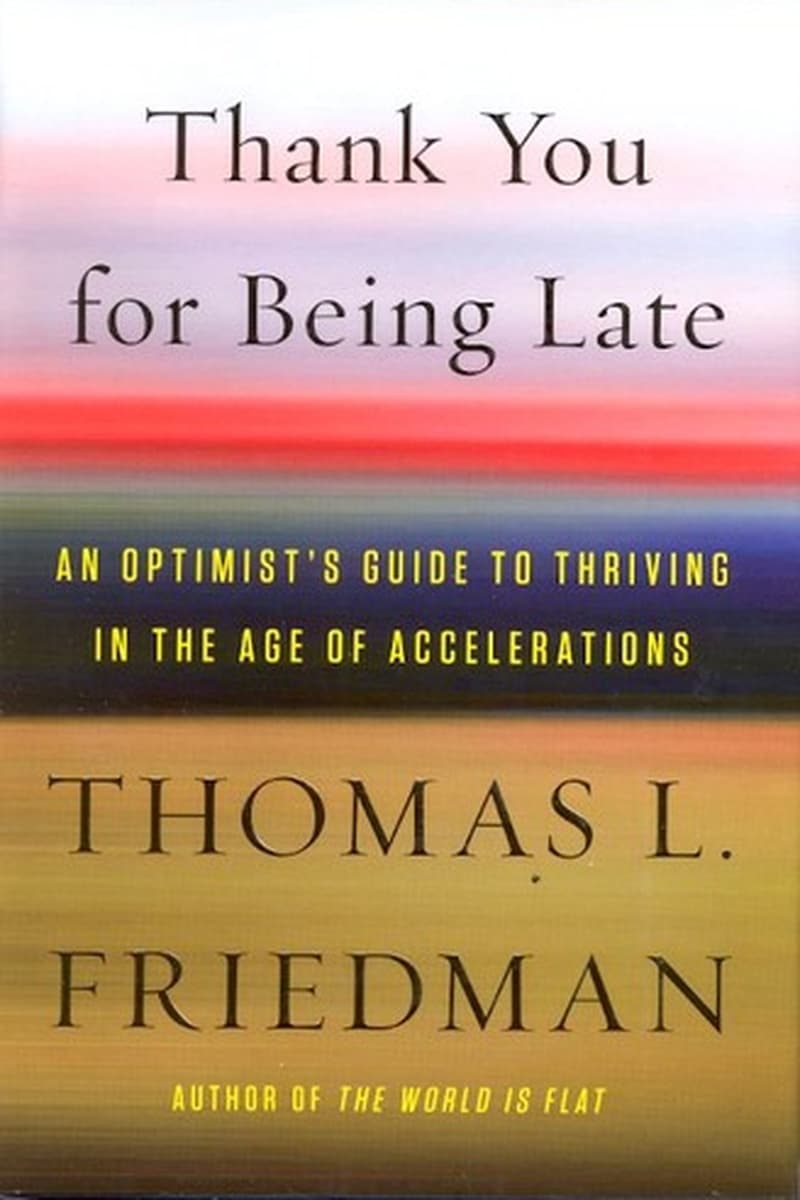
Thank You For Being Late
By Thomas L. Friedman
Favorite quotes and key takeaways from this book.
“You also can’t have an effective column without some “take” on the biggest forces shaping the world in which we live and how to influence them. Your view of the Machine can never be perfect or immutable. It always has to be a work in progress that you are building and rebuilding as you get new information and the world changes. But it is very difficult to persuade people to do something if you can’t connect the dots for them in a convincing way—why this action will produce this result, because this is how the gears and pulleys of the Machine work.”
Key takeaway
To stand out you need a POV, but make sure you approach the POV with a Bayesian mindset and constantly update it. Lastly, to be influential you need to be able to communicate and tell a story of how the dots connect
“Indeed, as the world becomes more interdependent and complex, it becomes more vital than ever to widen your aperture and to synthesize more perspectives.”
Key takeaway
DIversity is key when everything is connected
“To illustrate this kind of exponential growth, Brynjolfsson and McAfree recalled the famous legend of the king who was so impressed with the man who invented the game of chess that he offered him any reward. The inventor of chess said that all he wanted was enough rice to feed his family. The king said, “Of course, it shall be done. How much would you like?” The man asked the king to simply place a single grain of rice on the first square of a chessboard, then two on the next, then four on the next, with each subsequent square receiving twice as many grains as the previous one. The king agreed, noted Brynjolfsson and McAfee—without realizing that sixty-three instances of doubling yields a fantastically big number: something like eighteen quintillion grains of rice. That is the power of exponential change. When you keep doubling something for fifty years you start to get to some very big numbers, and eventually you start to see some very funky things that you have never seen before.”
Key takeaway
Compounding and exponential growth is hard to wrap your head around but it is real and jawdropping
“I don’t care how much progress you make this month; my job is to cause your rate of improvement to increase—how do we make the same mistake in half the time for half the money.”
Key takeaway
The goal is to improve faster than anyone else
“There are some ways of being, like riding a bicycle, where you cannot stand still, but once you are moving it is actually easier. It is not our natural state. But humanity has to learn to exist in this state.”
Key takeaway
The only stability moving forward will be dynamic stability
“That is why Hadoop is now the main operating system for data analytics supporting both structured and unstructured data. We used to throw away data because it was too costly to store, especially unstructured data. Now that we can store it all and find patterns in it, everything is worth vacuuming up and saving. “If you look at the quantity of data that people are creating and connecting to and the new software tools for analyzing it—they’re all growing at least exponentially,” said Cutting.”
Key takeaway
Moore’s law has made it cost effective to save more and more data which can then be used to train machine learning for better and new insights
“What the DOS operating system did, in essence, was abstract away the differences in hardware between every computer. It didn’t matter if you bought a Dell, an Acer, or an IBM. They all suddenly had the same operating system. This made desktop and laptop computers into commodities—the last thing their manufacturers wanted. Value then shifted to whatever differentiated software you could write that would work on top of DOS—and that you could charge each individual to use. That was how Microsoft got very rich.”
Key takeaway
The definition of aggregation theory
“Software is this magical thing that takes each emerging form of complexity and abstracts it away. That creates the new baseline that the person looking to solve the next problem just starts with, avoiding the need to master the underlying complexity themselves. You just get to start at that new layer and add your value. Every time you move the baseline up, people invent new stuff, and the compounding effect of that has resulted in software now abstracting complexity everywhere.”
Key takeaway
Software is really standing on the shoulder of giants, while hiding the complexity in the process
“The personal drone is basically the peace dividend of the smartphone wars, which is to say that the components in a smartphone—the sensors, the GPS, the camera, the ARM core processors, the wireless, the memory, the battery—all that stuff, which is being driven by the incredible economies of scale and innovation machines at Apple, Google, and others, is available for a few dollars. They were essentially “unobtainium” ten years ago. This is stuff that used to be military industrial technology; you can buy it at RadioShack now. I’ve never seen technology move faster than it’s moving right now, and that’s because of the supercomputer in your pocket.”
Key takeaway
The smartphone supply chain and Moore’s Law have made components so cheap that you can make virtually anything today
“If you look back over human history, only a few energy sources fundamentally changed everything for most everyone—fire, electricity, and computing.”
Key takeaway
Computing is on the same plane as the industrial revolution
“If you give the computer enough examples of what is right and what is wrong—and in the age of the supernova you can do that to an almost limitless degree—the computer will figure out how to properly weight answers, and learn by doing. And it never has to really learn grammar or Urdu or Chinese—only statistics!”
Key takeaway
Computers think in 1s and 0s and thus learn through statistics.
“When all of these toolboxes and components are in the cloud, available through open source, and infinitely mashable thanks to interoperable APIs, “it is all about how you put them together that creates the customer value,” said Ashe.”
Key takeaway
MLaaS means anyone can create functions that solve jobs-to-be-done
“To be blunt, adds Adam Sweidan, “we have reaped the rewards of technological progress without due concern for its unintended consequences.” All living things, he explained on his blog, “exist in and as ecosystems,” which are the foundation of all life and commerce. “The degradation of that foundation will eventually cause the pyramid to crumble.”
Key takeaway
Because everything is interconnected, when we change one thing, we often don’t recognize the unintended consequences
“That recursive loop really defines work and learning today. And that is why self-motivation is now so much more important” —because so much of learning will now have to happen long after you have left high school, college, or your parent’s home—not in the discipline of a classroom.”
Key takeaway
Self-motivation is so important today because learning is a constant now if you want to advance with technology
“Every job is also being pulled apart faster. For instance, being a cow milker may become disaggregated. The high-skilled part of that job may move up—now you either have to learn computing or become a veterinarian who understands the anatomy of cows or be a big data scientist who can analyze a cow’s behavior. At the same time the less skilled part of that job—herding cows into and out of the milking barn and cleaning up their manure—may get pulled down so that it can be done by anyone for a minimum wage (and probably soon by a robot). This is a broad trend in the workplace, as Bessen noted: the skilled part of each job requires more skill and rewards more skill, and the routine, repetitive part, which can much more easily be automated, will pay minimum wages or just be given over to a bot.”
Key takeaway
The internet is taking away the middle in the workforce. You either move up the stack because you are smart or automation moves down the stack to replace repetition with bots
“When a company like Udacity can respond to a major technological leap forward, such as TensorFlow from Google, and offer a course online to teach it to anyone in the world within three months, the word is going to get out and the market will change.”
Key takeaway
Current education systems can’t adapt quickly enough to the change in skills. Online companies like Udacity are more nimble and thus will adapt to the market more effectively over time
“We have to move to more hiring based on mastery, not history.”
Key takeaway
In the world today what matters more is if you can learn and adapt rather than what you have done since it will be outdated so quickly
“Warren Buffet says, “You only find out who is swimming naked when the tide goes out.”
Key takeaway
True talent shows when shit hits the fan
“On average, greater diversity leads to greater productivity in plant communities, greater nutrient retention in ecosystems and greater ecosystem stability.”
Key takeaway
Diversity leads to better products in both nature and the workplace
“Let’s say you’re three under for the day but you drive it in a divot at 16. Norman would look at me and say, ‘Bruce, can you believe my bad luck?’ Tom would look at the ball, look at the divot and say, ‘Bruce, watch this!’” There are people who are constantly cursing their luck, and there are people who will play the ball as best they can from wherever it lies and see it as a challenge. They know that the one thing they can control is not the bounce of the ball but their own attitude toward hitting it. In that context self-confidence and optimism are powers unto themselves.”
Key takeaway
While you cannot control certain things, you can control your attitude and response to those same things
“When you are an owner, you care, you pay attention, you build stewardship, and you think about the future. If you build a house for a quick flip, how strong will you build its foundation? People always tend to cut corners in a place where they won’t actually be living. And that is why I have so often over the years quoted the dictum “In the history of the world, no one has ever washed a rented car.” Ownership focuses you on long-term thinking over short-term, and on strategy over tactics.”
Key takeaway
Ownership typically leads to long term outlook rather than short term profits
“I had to come up with a different leadership technique. I knew that children are often given two choices for food: “Do you want carrots or apples for a snack?”—both options of which mom approves of, but giving a child the option gives him/her a choice and [makes] them learn to own that decision. I tried a similar technique with my chiefs. I introduced a problem/issue, solicited their advice/ideas, and ultimately came up with two options for action; one was usually a better option than the other, and they naturally chose the option I liked best. But it appeared—to them, at least—that they had a choice—and, therefore, buy-in. It worked at the training command, so I applied the same technique with many decisions as a captain of a ship.”
Key takeaway
A good leadership technique is getting people involved in the decision making process, even if they are merely choosing between options
“This was the broad and defining trend of American politics in the twentieth century that shaped many of the key planks of the “left” and “right” political agendas we know today—with the conservative right tending to be more sympathetic to the interests of owners and capital, always looking for more market-based solutions and less federal government regulation, and the liberal left tending toward more government-led solutions that promoted not just equal opportunities but equal outcomes, particularly for minorities and the poor.”
Key takeaway
Mother Nature is a conservative, she favors market based solutions of natural selection
“As a social species, being part of a group has survival value. Evolution also may have adapted the brain to experience a sense of reward when we did things with and for other people—dancing together especially in synchrony can signal that you’re actually simpatico with lots of other people. The researchers think this is why so many cultures have synchronized dancing and why it might have health benefits.”
Key takeaway
Man is social by nature
“The heart pumps in two cycles—systole, when it contracts, and diastole, when it relaxes. And one of the things we often think is that contraction is the most important phase, because that is what gets the blood pushed out everywhere around your body. But you realize when you study medicine that it’s in diastole—when the heart relaxes—that the coronary blood vessels fill and supply the heart muscle with the lifesaving, sustaining oxygen that it needs. So without diastole there can be no systole—without relaxation there can be no contraction.”
Key takeaway
The Yin and Yang of the heart