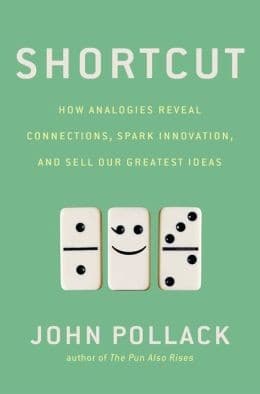
Shortcut: How Analogies Reveal Connections, Spark Innovation, and Sell Our Greatest Ideas
By John Pollack
Favorite quotes and key takeaways from this book.
“The word analogy traces its linguistic roots to the Greek analogia, a mathematical term meaning proportion, or equality of ratios.”
Key takeaway
An analogy is simply a model
“In short, when presented with the words flying pig, the actual image we construct in our mind’s eye depends on an infinitely rich array of inputs and experiences that vary from person to person.”
Key takeaway
Your experiences influence how you form and perceive analogies
“First, one can only describe or explain something new in an effective way by using concepts with which an audience is already somewhat familiar.”
Key takeaway
You can only explain new things with things people already know of. Usually you just do it in a new way
“Use the familiar to explain something less familiar. Highlight similarities and obscure differences. Identify useful abstractions Tell a coherent story. Resonate emotionally.”
Key takeaway
“Use the familiar to explain something less familiar. Highlight similarities and obscure differences. Identify useful abstractions Tell a coherent story. Resonate emotionally.”
“Rather, breakthroughs are the rambunctious progeny of many other ideas, jostling one another in a crowded intellectual environment, where greater diversity, accumulating insights, and chance encounters expand the range of possible combinations. And it is only by making analogies that we connect ideas from one realm to another in a way that is relevant or useful, revealing the adjacent possible.”
Key takeaway
Analogies are connecting the dots to form new ways of thinking and perspectives
“Be persistent. In working out an invention, the most important quality is persistence,” Edison said. “Nearly every man who develops a new idea works it up to a point where it looks impossible, and then he gets discouraged. That’s not the place to get discouraged, that’s the place to get interested.”
Key takeaway
Persistency and grit are common amongst innovators
“Put another way, we can only conceive, understand, or explain something new in terms of what we already know.”
Key takeaway
Everything is a remix
“In an extreme view, the world can be seen only as connections, nothing else,’ Berners-Lee wrote, adding that, “a piece of information is really defined only by what it’s related to, and how it’s related.” For example, while dictionaries define the meaning of words, each definition is itself composed of still more words. As such, every word’s definition depends on other, related definitions for its meaning. “Tree structures is everything,” he wrote.”
Key takeaway
Everything is a remix. Connecting the dots in new ways is the only way to form something new. All ideas come from existing ideas.
“Conceptually, the human brain functions in a similar way. “There are billions of neurons in our brains, but what are neurons? Just cells,” Berners-Lee wrote. “The brain has no knowledge until connections are made between neurons. ALl that we know, all that we are, comes from the way our neurons are connected.”
Key takeaway
The world wide web is structured like neurons in our brain. Neurons are worthless unless they are connected. Just like information is worthless unless it is connected.
“The web is also accelerating the pace of innovation, as it offers people hyperlinked shortcuts to related information and others interested in those same ideas.”
Key takeaway
Innovations are happening at an unbelievable pace now because of the access to information the internet has provided
“Innovators are those who spot useful analogies before others do and figure out how to put them to work.”
Key takeaway
Innovators are people who make connections and spot analogies before other people follow suit
“Emotions, once triggered, are like a genie released from a bottle - hard to recapture and cork.”
Key takeaway
You can’t take back emotions once they are felt
“The condor won. The condor took the least amount of energy to get from here to there,” Jobs told the audience. “And man didn’t do so well; he came in with a rather unimpressive showing about a third of the way down the list. But fortunately, someone at Scientific American was insightful enough to test man with a bicycle. And man with a bicycle won - twice as good as the condor. All the way off the list. And what it showed was that man as a toolmaker has the ability to make a tool to amplify an inherent ability he has. And that’s exactly what we are doing here at Apple. It’s exactly what we are doing here.”
Key takeaway
The Mac was a bicycle for the brain. Man with tools can amplify what he does. Man PAIRED with machine is bigger, stronger, faster
“As Jobs described it, Apple was building a “bicycle for the mind” - a tool that could take people’s minds anywhere they could possibly imagine and multiply its power.”
Key takeaway
Tools multiply powers
“Again, you can’t connect the dots looking forward; you can only connect them looking backwards,” Jobs reiterated. “So you have to trust that the dots will somehow connect in your future. You have to trust in something- your gut, destiny, life, karma, whatever. This approach has never let me down, and it has made all the difference in my life.”
Key takeaway
Connecting the dots is making analogies
“The urge to model is nothing new. Albert Einstein once noted that poets, painters, philosophers, and theoretical physicists all pursue a similar human impulse: to express what they see in nature and create “a simple and synoptic image of the surrounding world…”
Key takeaway
Models and analogies are very similar and frequent in the arts and sciences. As humans, we seek patterns, and ways to describe these patterns simply to others
“Because models are analogies, and analogies are models; some are expressed as mathematical equations, some are visual in nature, such as maps and diagrams, and some take verbal form.”
Key takeaway
Analogies can come in any form, just like models come in various forms