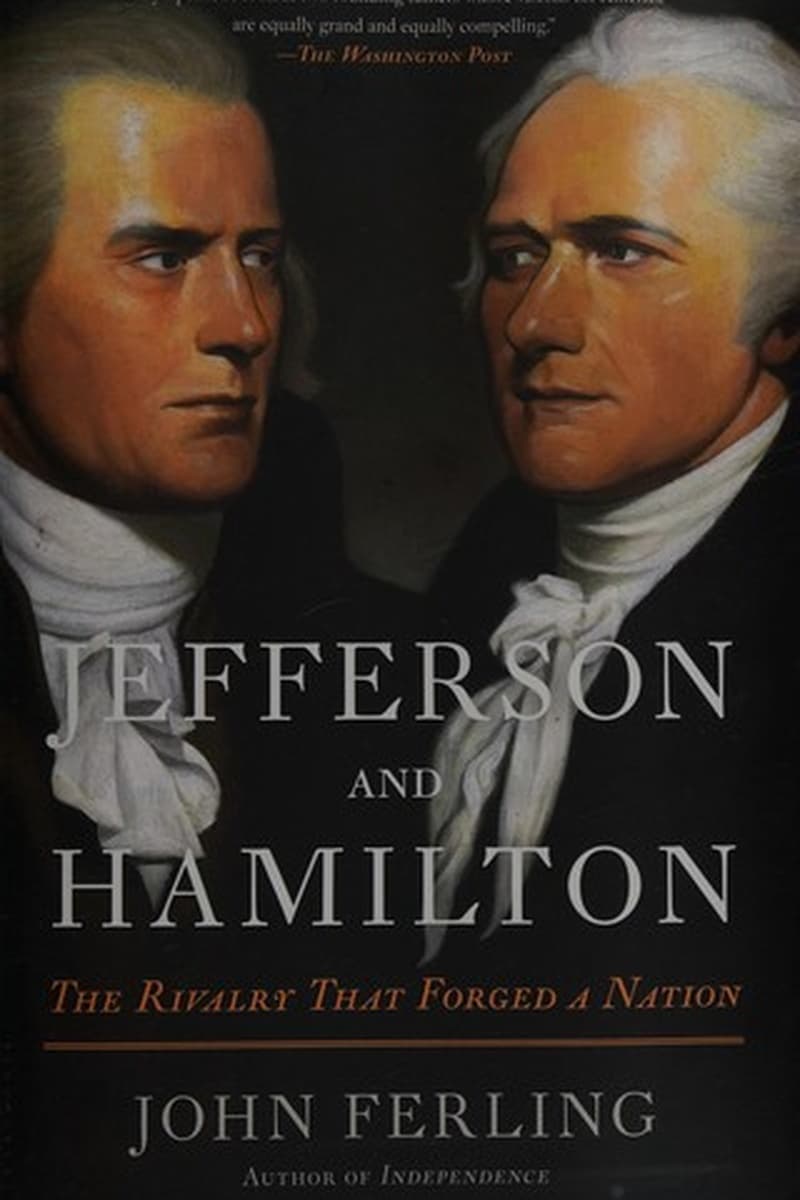
Jefferson and Hamilton: A Rivalry That Forged a Nation
By John Ferling
Favorite quotes and key takeaways from this book.
“Hamilton’s political philosophy was strikingly unlike that of Jefferson’s. Their differences were rooted in their conflicting views of human nature. Jefferson was an optimist; Hamilton was a pessimist who, in the words of one scholar, held “mankind in pragmatic distrust.” He saw humankind as the pawn of passion, and in numerous writings Hamilton spoke of the intractable “avarice, ambition, interest which govern most individuals.” Given man’s ever-present “love of power,” “desire of preeminence and dominion,” irresistible “low intrigue” for gaining power, and propensity for deception once in power - in order to achieve greater power and make pawns of the weak - Hamilton harbored doubts about man’s capability for self-government.”
Key takeaway
While Jefferson wanted self-government, Hamilton thought humans innately cannot govern themselves since they always seek power and will destroy everything in their way
“He played a key role in the Nationalists’ campaign to overthrow the Articles of Confederation, and his Herculean efforts helped secure the ratification of the Constitution. The consolidation he championed, the funding system he introduced, and the bank he fathered were pivotal in restoring the nation’s tattered credit, unfettering commercial activity, and returning prosperity to a new nation that had long endured a languid economy. Much of the capital that helped create the mills and factories that sprang up in the early nineteenth century was available because of Hamilton’s economic programs, as was the financial underpinning for the Erie Canal, which officially opened in 1825, linking the East and the West, the dream that Washington had cherished. There were perils in Hamilton’s vision, as Jefferson never tired of pointing out, but his financial system proved to be an amazing vehicle for the spread of wealth and opportunity.”
Key takeaway
As much as Jefferson disliked Hamilton’s moves, they created a ton of opportunity through financing
“Today’s America is more Hamilton’s America. Jefferson may never have fully understood Hamilton’s funding and banking systems, but better than most he gleaned the potential dangers that awaited future generations living in the nation state that Hamilton wished to bring into being. Presciently, and with foreboding, Jefferson saw the Hamiltonianism would concentrate power in the hands of the business leaders and financiers that it primarily served, leading inevitably to an American plutocracy every bit as dominant as monarchs and titled aristocrats had once been. Jefferson’s fears were not misplaced.”
Key takeaway
Jefferson feared that Hamilton’s system did not fix the problem, but merely moved it elsewhere. It would still result in monarchs and entitled aristocrats, they would just go by different names such as business leaders and financers
“Industrialization was a double-edged sword. It provided new social, cultural, and material opportunities, but wealth and power were soon concentrated in fewer and fewer hands.”
Key takeaway
The internet revolution has a lot of similarities to the industrial revolution. People who can harness the paradigm shift usually receive outsized profits as true power goes to very few people
“In manufacturing societies, only those at the top of the economic structure were truly independent and more or less in control of their destiny.”
Key takeaway
Power law of distribution applies to manufacturing societies where the rich get richer