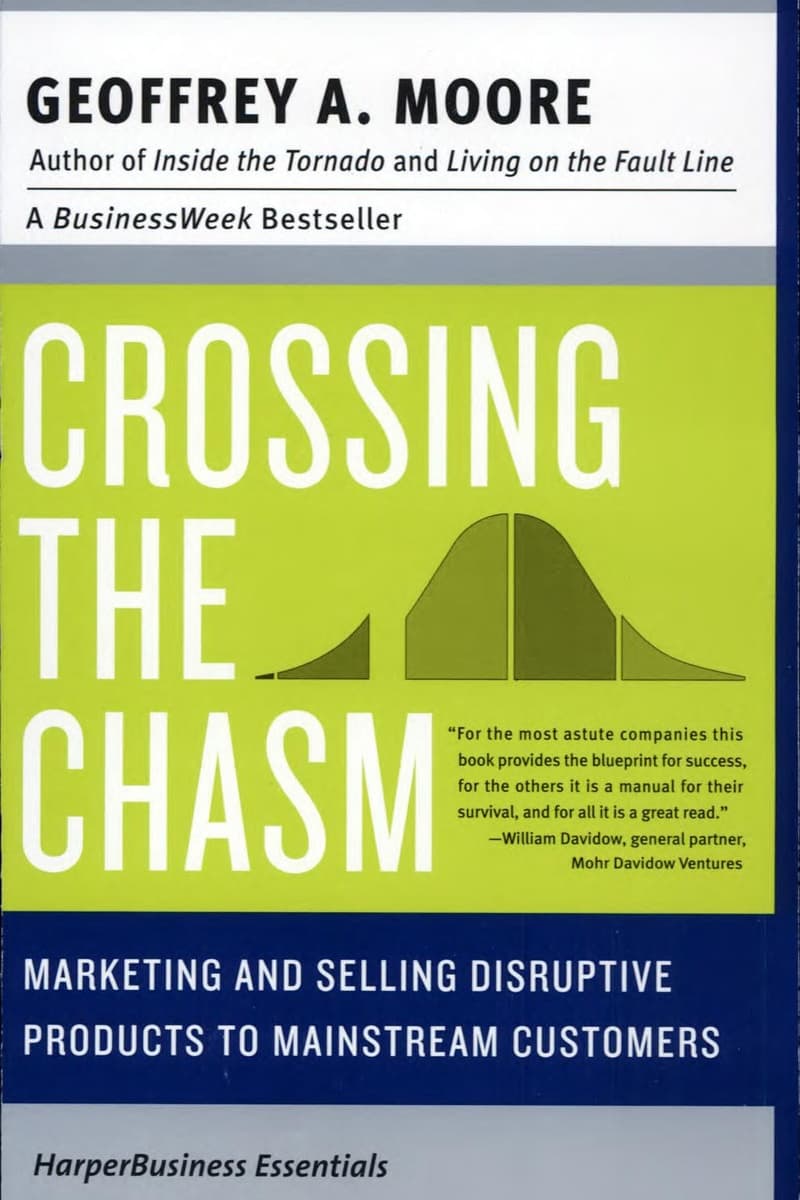
Crossing the Chasm: Marketing and Selling Disruptive Products to Mainstream Customers
By Geoffrey Moore
Favorite quotes and key takeaways from this book.
“First there is a market...Made up of innovators and early adopters, it is an early market, flush with enthusiasm and vision and, often as not, funded by a potful of customer dollars earmarked for accomplishing some grand strategic goal. Then there is no market...This is the chasm period, during which the early market is still trying to digest its ambitious projects, and the mainstream market waits to see if anything good will come of them. Then there is. If all goes well, and the product and your company pass through the chasm period intact, then a mainstream market does emerge, made up of the early and the late majority. With them comes the real opportunity for wealth and growth.”
Key takeaway
True growth doesn’t come until you make it to the early majority and late majority
“The basis for reform is the principle that winning at marketing more often than not means being the biggest fish in the pond. If we are very small, then we must search out a very small pond, a target market segment that fits our size.”
Key takeaway
Segment the market until you can be the biggest fish in the pond
“Bowling pin” strategy, where one targets a given segment not just because one can “knock it over” but because, in so doing, it will help knock over the next target segment, and thus lead to market expansion. With the right kind of angle of attack, it is amazing how large and fast the chain reaction can be. So one is never necessarily out of the game, even when things are pretty bleak.”
Key takeaway
Bowling pin is the idea that you can target one segment and if you knock it over it could start a domino effect
“The key is to focus on convenience rather than performance, user experience rather than feature sets.”
Key takeaway
When going after conservatives, they are much more into the user experience than the tech specs. This is how you truly aggregate all of the users
“That’s it. That’s the strategy. Replicate D-Day, and win entry to the mainstream. Cross the chasm by targeting a very specific niche market where you can dominate from the outset, drive your competitors out of that market niche, and then use it as a base for broader operations. Concentrate an overwhelmingly superior force on a highly focused target. It worked in 1944 for the Allies, and it has worked since for any number of high-tech companies.”
Key takeaway
Land and expand
“The efficiency of the marketing process, at this point, is a function of the “boundedness” of the market segment being addressed. The more tightly bound it is, the easier it is to introduce messages into it, and the faster these messages travel by word of mouth.”
Key takeaway
The more you segment an audience the more targeted your messaging can be and the more it will resonate and thus spread organically
“Trying to cross the chasm without taking a niche market approach is like trying to light a fire without kindling.”
Key takeaway
You need to dominate a niche before you can move onto a larger market
“The fundamental principle for crossing the chasm is to target a specific niche market as your point of attack and focus all of your resources on achieving the dominant leadership position in that segment as quickly as possible.”
Key takeaway
Get to the market leadership position of a niche market first and then go from there
“Positioning exists in people’s heads, not in your words. If you want to talk intelligently about positioning, you must frame a position in words that are likely to actually exist in other people’s heads, and not in words that come straight out of hot advertising copy.”
Key takeaway
To better understand positioning, use words that your audience use
“Companies focus on making products easier to sell because that is what they are worried about—selling. They load their marketing communications with every possible selling argument, following the age-old axiom that if you throw a lot of mud at a wall, some of its bound to stick. Prospective customers shrink from this barrage, which in turn causes the salespeople to chase after them that much harder. Even though the words appear to address the customers’ values and needs, the communication is really focused on the seller’s attempt to manipulate them, a fact that is transparently obvious to the potential customer. It’s a complete turnoff—all because the company was trying to make its product easy to sell instead of easy to buy.”
Key takeaway
Focus on making the product easy to buy not easy to sell, this means put it in terms of the customers perspective not from your company perspective focusing on features no one cares about
“Can you explain your product in the time it takes to ride up in an elevator? Venture capitalists use this all the time as a test of investment potential. If you cannot pass the test, they don’t invest. Here’s why: 1. Whatever your claim is, it cannot be transmitted by word of mouth.”
Key takeaway
The elevator test is truly a word of mouth test, it needs to be easy to share with other people
“This is why Simon Sinek says in his much-viewed TED talk on innovation that the goal of an innovative company is not to do business with customers who need what you have (which is indeed the goal of most established enterprises, and should be) but rather to do business with customers who believe what you believe.”
Key takeaway
It can be very powerful when you find your tribe and they are willing to spread your mission by word of mouth because they truly believe in what you believe