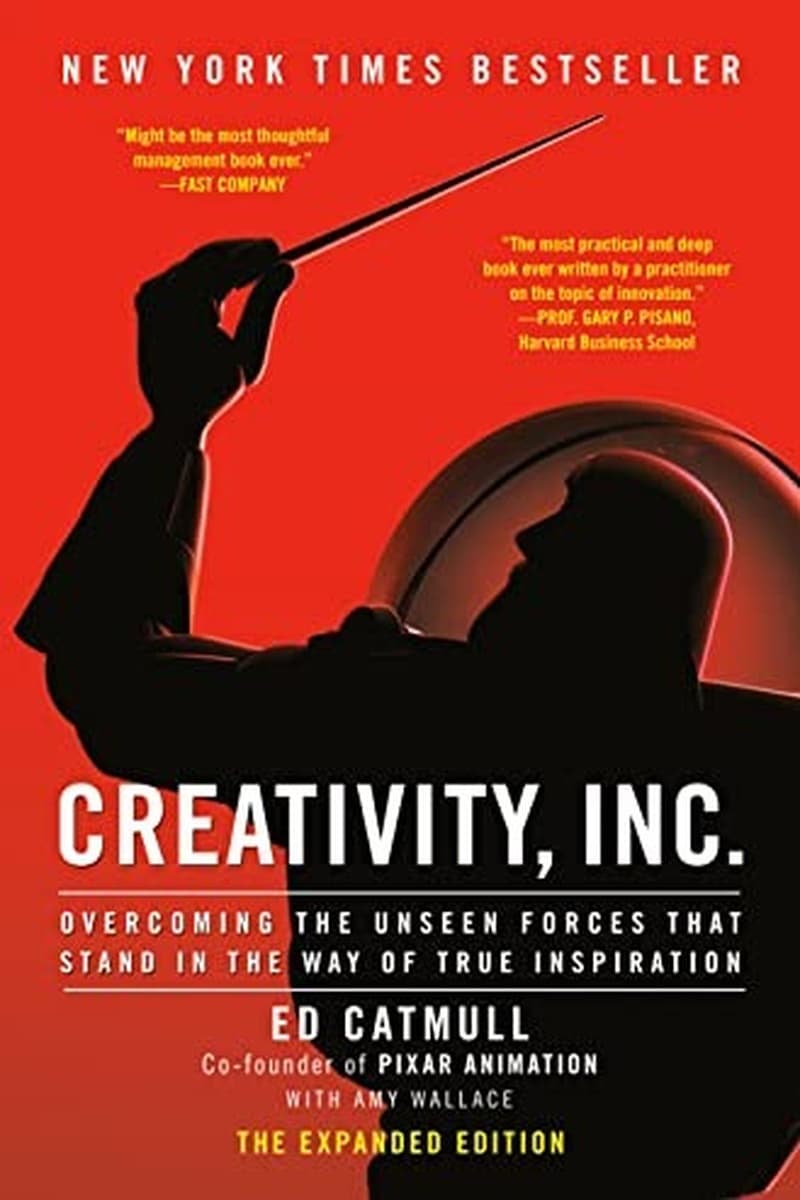
Creativity Inc: Overcoming the Unseen Forces That Stand in the Way of True Inspiration
By Ed Catmull
Favorite quotes and key takeaways from this book.
“What makes Pixar special is that we acknowledge we will always have problems, many of them hidden from our view; that we work hard to uncover these problems, even if doing so means making ourselves uncomfortable; and that, when we come across a problem, we marshal all of our energies to solve it.”
Key takeaway
No team or organization is perfect, look to uncover your weaknesses and strengthen them
“The thesis of this book is that there are many blocks to creativity, but there are active steps we can take to protect the creative process.”
Key takeaway
You can nurture creativity
“They must accept risk; they must trust the people they work with and strive to clear the path for them; and always, they must pay attention to and engage with anything that creates fear. Moreover, successful leaders embrace the reality that their models may be wrong or incomplete. Only when we admit what we don’t know can we ever hope to learn it.”
Key takeaway
Be weary of what makes employees fearful and seek to get rid of it. Understand you may not have all the answers or that your thinking is incomplete and always be open to learning and growing
“When it comes to creative inspiration, job titles and hierarchy are meaningless.”
Key takeaway
Creativity comes from anywhere
“The key is to look at the viewpoints being offered, in any successful feedback group, as additive, not competitive.”
Key takeaway
To receive successful feedback, think of it as additive not competitive
“Here are the qualifications required: The people you choose must (a) make you think smarter and (b) put lots of solutions on the table in a short amount of time
Key takeaway
you want people who challenge your views and provide solutions
“We need to think about failure differently. I’m not the first to say that failure, when approached properly, can be an opportunity for growth. But the way most people interpret this assertion is that mistakes are a necessary evil. Mistakes aren’t a necessary evil. They aren’t evil at all. They are inevitable consequence of doing something new (and, as such, should be seen as valuable; without them, we’d have no originality.”
Key takeaway
Mistakes, when approached the right way, can be a growing opportunity
“Failure is a manifestation of learning and exploration.”
Key takeaway
Failure just means you’re attempting new things
“Being open about problems is the first step toward learning from them. My goal is not to drive fear out completely, because fear is inevitable in high-stakes situations. What I want to do is loosen its grip on us. While we don’t want too many failures, we must think of the cost of failure as as investment in the future.
Key takeaway
We don’t want fear to dictate things. Failure is an investment in the future
“That means any outcome is a good outcome, because it yields new information.”
Key takeaway
You can learn from anything and everything
“Trusting others doesn’t mean that they won’t make mistakes. It means that if they do (of if you do), you trust they will act to help solve it. Fear can be created quickly; trust can’t. Leaders must demonstrate their trustworthiness, over time, through their actions - and the best way to do that is by responding well to failure.”
Key takeaway
Trust means allowing people to rebound from mistakes. Fear can be created quickly while trust takes time
“I’ve heard some people describe creativity as ‘unexpected connections between unrelated concepts of ideas.”
Key takeaway
Creativity is connecting the dots
“So we’ve covered change. Where does randomness fit in? Once, when i was on a retreat in Marin, I heard a delightful - and possibly apocryphal - story about what happened when the British introduced golf to India in the 1820s. Upon building the first golf course there, the Royal Calcutta, the British discovered a problem: Indigenous monkeys were intrigued by the little white balls and would swoop down out of the trees and onto the fairways, picking them up and carrying them off. This was a disruption, to say the least. In response, officials tried erecting fences to keep the monkeys out, but the monkeys climbed right over. They tried capturing and relocating the monkeys, but the monkeys kept coming back. They tried loud noises to scare them away. Nothing worked. In the end, they arrived at a solution: They added a new rule to the game- “Play the ball where the monkey drops it.”
Key takeaway
Embrace change, don’t fight it
“If you don’t try to uncover what is unseen and understand its nature, you will be ill prepared to lead.”
Key takeaway
To be a good leader you must constantly be looking for your blind spots
“Art teachers use a few different tricks to train new artists. They place an object upside down, for example, so that each student can look at it as a pure shape and not as a familiar, recognizable thing (a shoe say)”
Key takeaway
Flipping something upside down to change the perspective can help with art and creativity
“In my experience, creative people discover and realize their visions over time and through dedicated, protracted struggle. In that way, creativity is more like a marathon than a sprint.”
Key takeaway
Creative people struggle with an idea for a long time before coming to a creative resolution
“Athletes and musicians often refer to being in”the zone” - that mystical place where their inner critic is silenced and they completely inhabit the moment, where the thinking is clear and the motions are precise.”
Key takeaway
The zone is when you stop letting fear dictate
“Andrew compared making a movie to an archeological dig. This adds yet another element to the picture- the idea that as you progress, your project is revealing itself to you. “You’re digging away, and you don’t know what dinosaur you’re digging for,” Bob says. “Then, you reveal a little bit of it. And you may be digging in two different places at once and you think what you have is one thing, but as you go farther and farther, blindly digging, it starts revealing itself. Once you start getting a glimpse of it, you know how to better dig.”
Key takeaway
Solving a problem is like an archeological dig, you uncover it slowly, in different places and learn where to better dig as you go along
“What interests me is the number of people who believe that they have the ability to drive the train and who think that this is the power position - that driving the train is the way to shape their companies’ futures. The truth is, it’s not. Driving the train doesn’t set its course. The real job is laying its track.”
Key takeaway
Driving the train is not leading. Laying the track is leading
“Mindfulness helps us accept the fleeting and subjective nature of our thoughts, to make peace with what we cannot control. Most important, it allows us to remain open to new ideas and to deal with our problems squarely.”
Key takeaway
Mindfulness creates awareness which creates new perspectives to solve problems
“In a word: PERSIST. PERSIST on telling your story. PERSIST on reaching your audience. PERSIST on staying true to your vision…”
Key takeaway
Use grit. Be determined. Don’t give up
“It wasn’t that passion trumped logic in Steve’s mind. He was well aware that decisions must never be based on emotions alone But he also saw that creativity wasn’t linear, that art was not commerce, and that to insist upon applying dollars-and-cents logic was to risk disrupting the thing that set us apart. Steve put a premium on both sides of this equation, logic and emotion, and the way he maintained that balance was key to understanding him.”
Key takeaway
Creativity is not linear, there is no equation to solve it
“How do you prevent this from happening? The trick is to shift the emphasis in any meeting away from the source of an idea and onto the idea itself. People often place too much significance on the source of an idea, accepting it (or not criticizing it) because it comes from Steve or a respected director. But Steve had no interest in that kind of affirmation.
Key takeaway
Focus on the idea, not who came up with the idea
“This is, in effect, a form of storytelling - searching for the best way to frame and communicate an idea.”
Key takeaway
Storytelling is the framing of an idea
“Give a good idea to a mediocre team, and they will screw it up. Give a mediocre idea to a great team, and they will either fix it or come up with something better. If you get the team right, chances are that they’ll get the ideas right.”
Key takeaway
Execution (from a great team) is more important than the strategy
“Likewise, if someone disagrees with you, there is a reason. Our first job is to understand the reasoning behind their conclusion.”
Key takeaway
Find the reasoning behind any disagreement. Then address it
“Don’t wait for things to be perfect before you share them with others. Show early and show often. It’ll be pretty when we get there, but it won’t be pretty along the way. And that’s as it should be.”
Key takeaway
Bring people along on the journey and they can offer solutions
“A company’s communication structure should not mirror its organizational structure. Everybody should be able to talk to anybody.”
Key takeaway
Encourage collaboration
“Our job as managers in creative environments is to protect new ideas from those who don’t understand that in order for greatness to emerge, there must be phases of no-so-greatness. Protect the future, not the past.”
Key takeaway
Greatness takes time, nurture it and protect it and it will have a better chance to grow
“Don’t confuse the process with the goal. Working on our processes to make them better, easier and more efficient is an indispensable activity and something we should continually work on - but it is not the goal. Making the product great is the goal.
Key takeaway
Yes you want to make operations efficient but keep in mind that none of that matters unless a great product is made. Great product is the goal