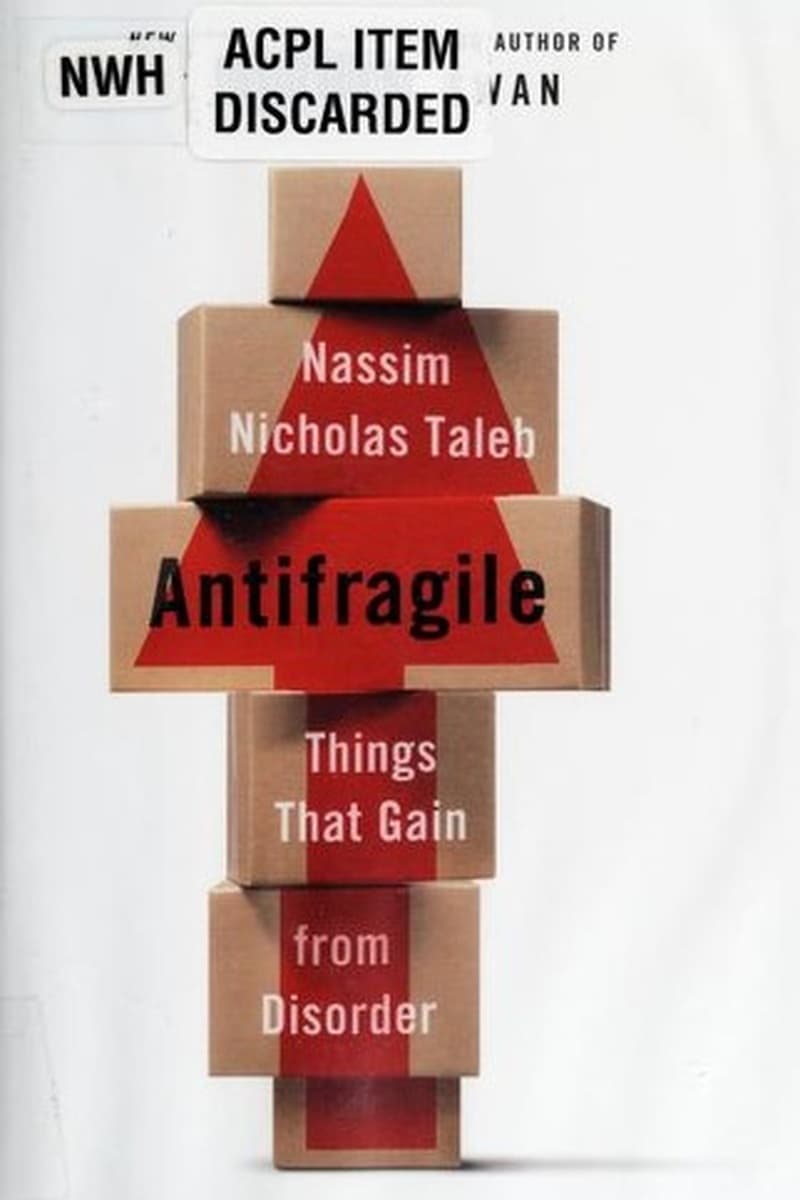
Antifragile: Things That Gain From Disorder
By Nassim Taleb
Favorite quotes and key takeaways from this book.
“But simplicity is not so simple to attain. Steve Jobs figured out that “you have to work hard to get your thinking clean to make it simple” That Arabs have an expression for trenchant prose: no skill to understand it, mastery to write it.”
Key takeaway
The paradox of simplicity is that it is often more complex than complexity. To write something simply is to truly understand it
“If one looks at history as a complex system similar to nature, then, like nature, it won’t let a single empire dominate the planet forever—even if every superpower from the Babylonians to the Egyptians to the Persians to the Romans to modern America has believed in the permanence of its domination and managed to produce historians to theorize to that effect. Systems subjected to randomness—and unpredictability—build a mechanism beyond the robust to opportunistically reinvent themselves each generation, with a continuous change of population and species.”
Key takeaway
History is subject to mother nature as well, which won’t let any one thing dominate for an extended period of time
“How does this layering operate? A tree has many branches, and these look like small trees; further, these large branches have many more smaller branches that sort of look like even smaller trees. This is a manifestation of what is called fractal self-similarity, a vision by the mathematician Benoit Mandelbrot. There is a similar hierarchy in things and we just see the top layer from the outside. The cell has a population of intracellular molecules; in turn the organism has a population of cells, and the species has a population of organisms. A strengthening mechanism for the species comes at the expense of some organisms; in turn the organism strengthens at the expense of some cells, all the way down and all the way up as well.”
Key takeaway
Fractal knowledge is taking relativity to both ends of the spectrum
“Further, the random element in trial and error is not quite random, if it is carried out rationally, using error as a source of information. If every trial provides you with information about what does not work, you start zooming in on a solution—so every attempt becomes more valuable, more like an expense than an error. And or course you make discoveries along the way.”
Key takeaway
Failure can help you learn too as long as you approach things in a certain way, you can’t just spray and pray. This is the importance of having a hypothesis
“A donkey equally famished and thirsty caught at an equal distance between food and water would unavoidably die of hunger or thirst. But he can be saved thanks to a random nudge one way or the other. This metaphor is named Buridan’s Donkey, after the medieval philosopher Jean de Buridan, who—among other, very complicated things—introduced the thought experiment. When some systems are stuck in a dangerous impasse, randomness and only randomness can unlock them and set them free. You can see here that absence of randomness equals guaranteed death.”
Key takeaway
Sometimes randomness can be that nudge in the right direction that saves you from yourself
“Fewer pedestrians die jaywalking than using regulated crossings. Some libertarians use the example of Drachten, a town in the Netherlands, in which a dream experiment was conducted. All street signs were removed. The deregulation led to an increase in safety, confirming the antifragilty of attention of work, how it is whetted by a sense of danger and responsibility. As a result, many German and Dutch towns have reduced the number of street signs. We saw a version of the Drachten effect in Chapter 2 in the discussion of the automation of planes, which produces the exact opposite effect than what is intended by making pilots lose alertness. But one needs to be careful not to overgeneralize the Drachten effect, as it does not imply the effectiveness of removing all rules from society. As I said earlier, speed on the highway responds to a different dynamic and its risks are different.”
Key takeaway
When less is taken care for you, you are more alert because of the exposure to the unknown
“The more frequently you look at data, the more noise you are disproportionately likely to get (rather than the valuable part, called the signal); hence the higher the noise-to-signal ratio. And there is a confusion which is not psychological at all, but inherent in the data itself. Say you look at information on a yearly basis, for stock prices, or the fertilizer sales of your father-in-law’s factory, or inflation numbers in Vladivostok. Assume further that for what you are observing, at a yearly frequency, the ratio of signal to noise is about one to one (half noise, half signal)—this means that about half the changes are real improvements or degradations, the other half come from randomness. This ratio is what you get from yearly observations. But if you look at the very same data on a daily basis, the composition would change to 95 percent noise, 5 percent signal. And if you observe data on an hourly basis, as people immersed in the news and market price variations do, the split becomes 99.5 percent noise and 0.5 percent signal. That is two hundred times more noise than signal–which is why anyone who listens to news (except when very, very significant events take place) is one step below sucker.”
Key takeaway
The more you look at data the more exposed you are to the noise
“The traditional understanding of Stoicism in the literature is of some indifference to fate—among other ideas of harmony with the cosmos that I will skip here. It is about continuously degrading the value of earthly possessions.”
Key takeaway
Stoicism is about degrading the value of earthly possessions and being able to live with the bare minimum needed to survive
“And the key phrase reverberating in Seneca’s oeuvre is nihil perditi, “I lost nothing,” after an adverse event. Stoicism makes you desire the challenge of a calamity. And stoics look down on luxury: about a fellow who led a lavish life, Seneca wrote: “He is in debt, whether he borrowed from another person or from fortune.”
Key takeaway
Stoics like randomness and major events because they aren’t attached to anything so the bigger the disaster the better because they have nothing to lose
“And one needs to be rational in not making trial and error completely random. If you are looking for your misplaced wallet in your living room, in a trial and error mode, you exercise rationality by not looking in the same place twice. In many pursuits, every trial, every failure provides additional information, each more valuable than the previous one—if you know what does not work, or where the wallet is not located. With every trial one gets closer to something, assuming an environment in which one knows exactly what one is looking for. We can, from the trial that fails to deliver, figure out progressively where to go.”
Key takeaway
This is why Silicon Valley is obsessed with failure, if done right. You can learn something by also learning what does not work
“Accordingly, wisdom you learn from your grandmother should be vastly superior (empirically, hence scientifically) to what you get from a class in business school (and, of course, considerably cheaper). My sadness is that we have been moving farther and farther away from grandmothers.”
Key takeaway
Grandmother wisdom passes the test of time, which is why it should not be overlooked
“Payoffs from research are from Extremistan; they follow a power-law type of statistical distribution, with big, near-unlimited upside but, because of optionality, limited downside. Consequently, payoff from research should necessarily be linear to number of trials, not total funds involved in the trials. Since, as in Figure 7, the winner will have an explosive payoff, uncapped, the right approach requires a certain style of blind funding. It means the right policy would be what is called “one divided by n” or “1/N” style, spreading attempts in as large a number of trials as possible: if you face n options, invest in all of them in equal amounts. Small amounts per trial, lots of trials, broader than you want. Why? Because of Extremistan, it is more important to be in something in a small amount than to miss it. As one venture capitalist told me: “The payoff can be so large that you can’t afford to not be in everything.”
Key takeaway
Try as many approaches as possible knowing the payoff from one has the ability to be huge
“The young Nietzsche wrote his first book, The Birth of Tragedy, while in his early twenties. He went after Socrates, whom he called the “mystagogue of science,” for “making existence appear comprehensible.” This brilliant passage exposes what I call the sucker-rationalistic fallacy: Perhaps—thus he [Socrates] should have asked himself—what is not intelligible to me is not necessarily unintelligent? Perhaps there is a realm of wisdom from which the logician is exiled? “What is not intelligible to me is not necessarily unintelligent” is perhaps the most potent sentence in all of Nietzsche’s century—and we used a version of it in the prologue, in the very definition of the fragilista who mistakes what he does not understand for nonsense.”
Key takeaway
Just because you can’t understand something doesn’t mean it’s nonsense. Nature works in mysterious ways
“For Tony, the distinction in life isn’t True or False, but rather sucker or nonsucker. Things are always simpler with him. In real life, as we saw with the ideas of Seneca and the bets of Thales, exposure is more important than knowledge; decision effects supersede logic. Textbook “knowledge” misses a dimension, the hidden asymmetry of benefits—just like the notion of average. The need to focus on the payoff from your actions instead of studying the structure of the world (or understanding the “True” and the “False) has been largely missed in intellectual history. Horribly missed. The payoff, what happens to you (the benefits or harm from it), is always the most important thing, not the event itself.”
Key takeaway
The function of x is more important than x.
“Someone with a linear payoff needs to be right more than 50 percent of the time. Someone with a convex payoff, much less. The hidden benefit of antifragility is that you can guess worse than random and still end up outperforming. Here lies the power of optionality—your function of something is very convex, so you can be wrong and still do fine—the more uncertainty, the better.”
Key takeaway
The beauty of antifragility is that you only need to be right once because the payoff will be so big
“Few realize that we are moving into the far more uneven distribution of 99/1 across many things that used to be 80/20: 99 percent of Internet traffic is attributable to less than 1 percent of sites, 99 percent of book sales come from less than 1 percent of authors...and I need to stop because numbers are emotionally stirring. Almost everything contemporary has winner-take-all effects, which includes sources of harm and benefits.”
Key takeaway
Internet is making the power law even more drastic, going from 80/20 to 99/1. It truly is winner-take-all now that everything is connected
“Time has sharp teeth that destroy everything,” declaimed the sixth-century (B.C.) poet Simonides of Ceos, perhaps starting a tradition in Western literature about the inexorable effect of time. I can trace a plethora of elegant classical expressions, from Ovid (tempus edax rerum—time devours everything) to the no less poetic twentieth-century Franco-Russian poetess Elsa Triolet (“time burns but leaves no ashes”).
Key takeaway
Time is the true test for everything
“So there is a logic to natural things that is much superior to our own. Just as there is a dichotomy in law: innocent until proven guilty as opposed to guilty until proven innocent, let me express my rule as follows: what Mother Nature does is rigorous until proven otherwise; what humans and science do is flawed until proven otherwise.”
Key takeaway
Mother nature is OG, she gets the benefit of the doubt. Humans are the new kids on the block, we have to prove ourselves
“A lesson I learned from this ancient culture is the notion of megalopsycho (a term expressed in Aristotle’s ethics), a sense of grandeur that was superseded by the Christian value of “humility.” There is no word for it in Romance languages; in Arabic it is called Shhm—best translated as nonsmall. If you take risks and face your fate with dignity, there is nothing you can do that makes you small; if you don’t take risks, there is nothing you can do that makes you grand, nothing. And when you take risks, insults by half-men (small men, those who don’t risk anything) are similar to barks by nonhuman animals: you can’t feel insulted by a dog.”
Key takeaway
If you take risks then you have upside, if you don’t take risks then you will never have any upside!
“More technically, we may never get to know x, but we can play with the exposure to x, barbell things to defang them; we can control a function of x, f(x), even if x remains vastly beyond our understanding. We can keep changing f(x) until we are comfortable with it by a mechanism called convex transformation, the fancier name for the barbell.”
Key takeaway
While you can’t control x, you can control the second order effects from x, getting them to be more favorable by making the benefits outweigh the consequences
“Remember that food would not have a taste if it weren’t for hunger; results are meaningless without effort, joy without sadness, convictions without uncertainty, and an ethical life isn’t so when stripped of personal risks.”
Key takeaway
Yin and yang